
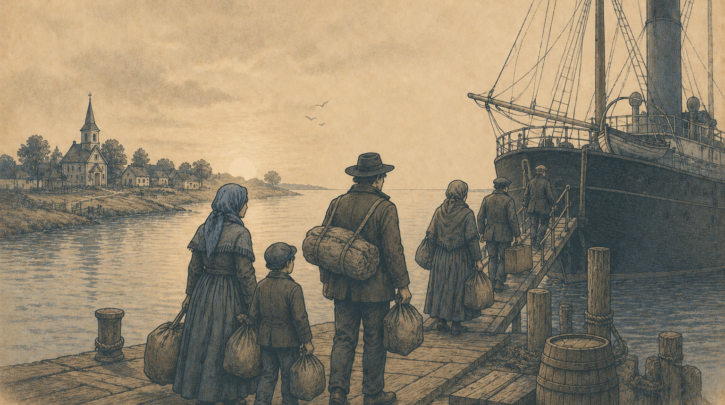

No event shapes Acadian genealogy more than the deportation the Acadians themselves call le Grand Dérangement—the Great Upheaval. Beginning in 1755, British authorities forcibly expelled more than ten thousand Acadians from their Maritime homeland, scattering families across two continents and destroying much of the documentary record in the process. Understanding what happened is essential to researching any Acadian line, because the deportation is the wall that stands across the middle of nearly every Acadian tree.
What happened
The Acadians had settled the region around the Bay of Fundy—today’s Nova Scotia, New Brunswick, and Prince Edward Island—beginning in the early 1600s, and had built a prosperous farming society on diked tidal marshland. Caught between French and British empires, they tried for decades to remain neutral. In 1755, with war between Britain and France looming, British authorities demanded an unconditional oath of allegiance. When the Acadians hesitated, the British ordered their removal.
Over the following years, soldiers burned villages, confiscated land, and loaded families onto ships. Communities that had existed for a century and a half were emptied. The expulsions continued through the early 1760s, touching virtually the entire Acadian population.
Not sure where to start with your French-Canadian ancestry?
Get the French-Canadian Genealogy Quick-Start Checklist — a 6-step path to your first real ancestor record, plus the surname quirk that trips up almost every beginner.
Where the Acadians went
The deportees were dispersed widely, and tracing where a family landed is the heart of post-1755 Acadian research:
- The British American colonies — many were shipped to ports from Massachusetts to Georgia, often unwelcome and impoverished.
- England and France — others were transported across the Atlantic, with French Acadians later resettled in various parts of France.
- Louisiana — over the following decades many made their way to Spanish Louisiana, where they became the Cajuns.
- Hiding and return — some escaped into the woods or to remote areas and, in later decades, returned to resettle parts of the Maritimes.
Why this is a records catastrophe
For genealogists, the deportation did three destructive things at once. It destroyed parish registers as churches and villages burned. It separated families, so that parents, children, and spouses appear afterward in different colonies under varying spellings. And it broke continuity, erasing the smooth register-to-register chain that makes Québec research so straightforward. Tracing a line through 1755 is the defining challenge of Acadian genealogy.
Because so many original Acadian registers were lost, Acadian research leans on reconstructed scholarship more than on raw record-pulling. The surviving Maritime registers that do exist are largely in the Drouin Collection (via Généalogie Québec and Ancestry)—so a single subscription covers both the Acadian fragments and any Québec lines in a mixed tree.
How to trace through the deportation
- Lean on the reconstructed dictionaries. Stephen White’s Dictionnaire généalogique des familles acadiennes (founding period to 1714) and Bona Arsenault’s history are built precisely to bridge the gap the lost registers leave.
- Use the censuses. Pre-deportation Acadian censuses list families by name and stand in for missing vital records; censuses taken in exile help track where people landed.
- Follow ship lists and resettlement records. These document the dispersal and the later returns.
- Search surviving registers in the Drouin Collection for the parishes and periods that escaped destruction.
For the full Acadian research workflow—distinct in many ways from St. Lawrence genealogy—see our dedicated guide to Acadian genealogy. And to follow the largest branch of the diaspora to the bayous, read from Acadian to Cajun.
Recommended reading (available on Amazon):
- Dictionnaire généalogique des familles acadiennes (Stephen A. White)
- Histoire et généalogie des Acadiens (Bona Arsenault)
Frequently asked questions
How many Acadians were deported?
More than ten thousand were expelled between 1755 and the early 1760s—the great majority of the entire Acadian population at the time.
Can I still trace an Acadian line through 1755?
Often yes, but not through a clean register chain. You rely on reconstructed dictionaries, censuses, and exile records to bridge the gap, which is why Acadian research is harder than Québec research.
A timeline of the expulsions
The Grand Dérangement was not a single event but a series of expulsions over roughly a decade. The first and most infamous removals came in 1755 from the mainland Nova Scotia settlements, including the Grand-Pré region. Further expulsions followed in subsequent years, reaching Île Saint-Jean (today’s Prince Edward Island) and Île Royale (Cape Breton) by the late 1750s—removals marked by terrible loss of life, including shipwrecks that drowned hundreds of deportees. Expulsions and flight continued into the early 1760s, by which point the historic Acadian communities had been almost entirely uprooted.
Records the deportation itself created
Paradoxically, the upheaval generated records of its own that genealogists now depend on. British military and colonial authorities kept lists of those embarked and those received at various ports. Colonies where deportees landed sometimes recorded them for relief or administration. French and Spanish authorities documented the Acadians who reached France and, later, Louisiana. These dispersal records—ship lists, relief rolls, resettlement registers—are how you track a family across the scattering when the home registers are gone.
A research walkthrough
- Establish the family in a known pre- or post-deportation location using surviving registers and censuses.
- Use the reconstructed dictionaries (White, Arsenault) to bridge across 1755.
- Trace the dispersal with ship lists and the records of the colony, country, or Louisiana district where the family resurfaced.
- Read our Acadian genealogy guide for the full method, and the Cajun connection if the trail leads to Louisiana.
Identifying a deported line in your tree
How do you know whether the Grand Dérangement runs through your family? The signals are a combination of surname (the classic Acadian names—Leblanc, Landry, Thériault, Hebert, Doucet, Bourgeois, Comeau, and others), geography (Maritime, then New England or Louisiana), and a gap or relocation around the late 1750s where a family vanishes from one place and reappears, often respelled, in another. When you see that pattern—a Maritime Acadian family that resurfaces in exile—you are looking at a deported line, and you switch from register-chasing to the reconstructed-source methods built for it.
Memory and the modern record
The deportation remains central to Acadian identity, and that living memory has fed real genealogical resources: commemorations, scholarly projects, and societies have assembled and published research on the deportees and their descendants. For researchers this means a deported ancestor, though hard to trace through raw registers, is often well documented in the secondary literature—one more reason Acadian genealogy relies on the reconstructed dictionaries and published studies described in our Acadian genealogy guide rather than on an unbroken chain of original records.