
Open your DNA match list for the first time as a French-Canadian descendant and the experience is faintly absurd: thousands of matches, dozens labelled as close cousins, shared-centimorgan totals that seem to make half of Québec your second cousin. Before you start drawing those people into your tree, you need to understand the phenomenon that produced that list—endogamy—because almost every one of those numbers is, in a specific and predictable way, lying to you.
What endogamy is
Endogamy is the practice of marrying within a relatively closed community over many generations. When a population descends from a small founding group and then grows largely from within—marrying neighbours, cousins of cousins, families it has intermarried with for centuries—the same ancestors get recycled through the family tree again and again. The French-Canadian population is one of the most studied examples in the world.
New France was founded by a comparatively small number of settlers. The roughly 800 Filles du Roi, the soldiers of the Carignan-Salières Regiment who stayed, and the other founding families produced an enormous modern population—but they did so mostly by intermarrying among themselves, generation after generation, in the parishes along the St. Lawrence. Four centuries of that, and you arrive at today’s reality: if your roots are in Québec, you are related to other Franco-descendants not once but through dozens or hundreds of separate lines at the same time.
Not sure where to start with your French-Canadian ancestry?
Get the French-Canadian Genealogy Quick-Start Checklist — a 6-step path to your first real ancestor record, plus the surname quirk that trips up almost every beginner.
Pedigree collapse
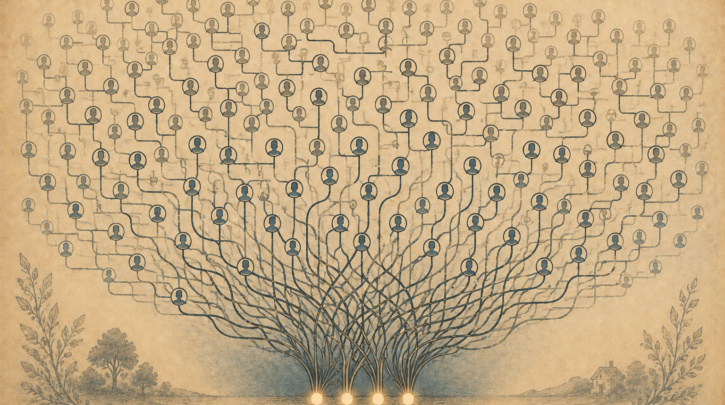
The mathematical companion to endogamy is pedigree collapse. In theory you have 1,024 ancestors ten generations back. In an endogamous population you do not—the same couples occupy multiple slots in your pedigree, so the true number of distinct ancestors is far smaller. A single founding couple from the 1600s might be your ancestor through five, ten, twenty different descent paths. You will see this directly in PRDH when the same names keep reappearing as you climb.
Pedigree collapse is why French-Canadian trees, traced on paper, are so satisfyingly deep and so densely interconnected. It is also why the DNA gets confusing: you and a match may share DNA from several common ancestors at once, and the testing companies add it all together into one inflated total.
Why your match numbers are inflated
DNA testing companies estimate how closely you are related to a match by the total amount of DNA you share, measured in centimorgans (cM). Those estimates are built on the assumption of an outbred population—people whose ancestors did not repeatedly intermarry. For French-Canadians that assumption breaks. Because you share ancestors through many paths, you share more total DNA with a given cousin than the simple relationship would predict, so:
- A true 5th or 6th cousin can show up with enough shared DNA to be labelled a 3rd–4th cousin.
- “Distant” matches pile up in the hundreds and thousands, far more than an outbred person would see.
- Tools like ThruLines and Theory of Family Relativity confidently propose connections that are real but more distant, and through more lines, than the label suggests.
None of this is a malfunction. It is the honest output of a model that does not know your ancestors married each other repeatedly. Once you expect it, the match list stops being misleading and becomes useful again.
How to read an endogamous match list
You cannot make endogamy disappear, but you can stop it from leading you into false conclusions:
- Distrust the predicted relationship label. Treat “3rd–4th cousin” as “related somehow, probably further back than this says.”
- Demand a documented path. Never add a match to your tree on shared cM alone. Find the actual common ancestor in the parish records and confirm the line both ways.
- Use the largest shared segment, not just the total. A single long shared segment is more informative than a high total built from many short ones, which is exactly what endogamy manufactures.
- Prioritise your closest matches. First and second cousins are reliable even in an endogamous population; it is the mid-range matches where the inflation does its damage.
- Use a chromosome browser where you can. MyHeritage and FamilyTreeDNA offer one; it lets you see whether matches who supposedly share an ancestor actually share the same segment.
Endogamy is not a dead end
It is tempting to read all this as “DNA is useless for French-Canadians.” That is the wrong lesson. DNA still confirms relationships you have documented, still occasionally reveals an unknown parent or a misattributed line, and still connects you to living cousins with photos and stories. What endogamy changes is the method: you lead with the records and use DNA to confirm, rather than letting a cM total write your tree for you.
This is, in a sense, good news for French-Canadians specifically, because the records are extraordinary. Few populations on earth can document their families as completely as Québec families can, through four centuries of parish registers and the PRDH index. Where another genealogist might be forced to lean on DNA, you can usually find the paper—and the paper is what settles it.
Want to put this into practice? See how to verify a noisy match against the registers in connecting DNA to Québec records, and choose the right test with the best tools for endogamy on our DNA hub.
The bottom line
In French-Canadian genetic genealogy, the match list is real but the labels are optimistic, the totals are inflated, and the “close cousins” are often not. Read every prediction as a hypothesis to be tested in the documents, lean on your largest shared segments and your closest matches, and let four centuries of Québec record-keeping do the work the centimorgans cannot. Done that way, endogamy stops being a trap and becomes just another feature of a family history that happens to be unusually well documented.
A worked example of how the numbers mislead
Imagine the tools tell you a match is your “3rd–4th cousin,” sharing, say, the kind of total you would normally expect from someone two or three generations closer than they really are. In an outbred family you would look for a common great-great-grandparent. In a French-Canadian family that same total might come from a 6th-cousin relationship—but counted through four or five different ancestral couples at once, each contributing a little shared DNA that the company simply adds together. Go looking for a recent common ancestor and you will not find one, because there isn’t a single recent one; there are several older ones.
This is why so many newcomers to French-Canadian DNA feel they have hit a wall: they trust the predicted relationship, search for a close ancestor that does not exist, and conclude the test is broken. The test is fine. The model behind the prediction simply assumes a kind of family tree—one without repeated intermarriage—that your ancestors did not have. Adjust the expectation and the wall disappears.
Tools that help with endogamy
A few features are worth seeking out specifically because they cut through the noise. A chromosome browser (on MyHeritage and FamilyTreeDNA) lets you check whether matches who supposedly share an ancestor actually share the same physical segment. Shared-match clustering groups relatives by branch, which is more reliable than any single relationship estimate. And third-party tools that many French-Canadian researchers use can visualise these clusters at scale. None of them removes endogamy—nothing does—but together they let you work with it instead of being fooled by it.