
Ask where French-Canadians come from and the honest answer is surprisingly concentrated: not all of France, but a cluster of regions in the northwest, plus the great Atlantic ports. Understanding this geography does two things—it tells you where to look once you identify a first immigrant ancestor, and it explains why so many French-Canadian families share the same handful of home provinces.
The northwestern heartland
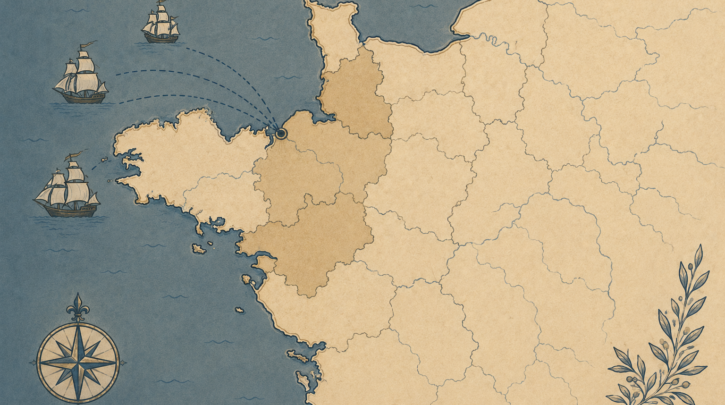
The founders of New France came overwhelmingly from northwestern and west-central France. A handful of provinces account for the large majority of immigrants:
- Normandy — the single largest contributor, with heavy emigration from the ports and countryside around Rouen and the coast.
- Perche — a small region that punched far above its weight, thanks to organized recruitment (notably by Robert Giffard around Tourouvre) that sent whole groups of Percheron families to the colony.
- Poitou and Aunis — the hinterland of La Rochelle, the colony’s most important embarkation port, which funneled large numbers of settlers.
- Île-de-France — the Paris region, a major source especially for the Filles du Roi.
- Saintonge, Anjou, Maine, Brittany, and Champagne — each adding meaningful numbers.
Not sure where to start with your French-Canadian ancestry?
Get the French-Canadian Genealogy Quick-Start Checklist — a 6-step path to your first real ancestor record, plus the surname quirk that trips up almost every beginner.
Why these regions?
The pattern is not random. Three forces shaped it. First, ports: emigration flowed through the Atlantic harbors—La Rochelle above all, plus Dieppe, Rouen, Saint-Malo, and Honfleur—so the regions feeding those ports sent the most people. Second, recruiters: organized efforts like Giffard’s Perche recruitment created chains of migration from specific districts. Third, economic pressure: regions with land shortage and hardship produced more willing emigrants. Together these concentrated the colony’s origins in the northwest.
What this means for your research
When you trace a line back to its immigrant, you can make an educated first guess at the region—but you should always confirm rather than assume. Two same-named families can come from opposite ends of France. The tools that pin down the actual parish are:
- Fichier Origine — the free database that links thousands of pioneers to their birth parish in France, reachable via BAnQ partners.
- The immigrant’s marriage contract — which sometimes states the home parish outright.
- Pioneer dictionaries (PRDH, Jétté) — which frequently record the French origin.
Identifying your immigrant ancestor is a records job: work back through marriages on Généalogie Québec and PRDH-IGD until you reach the one born in France, then use the free Fichier Origine via BAnQ to pin down the French parish.
Regions to watch for in the records
As you read your immigrant’s records, look for the phrase identifying origin—often “natif de [parish], évêché de [diocese]” or “de la paroisse de …” The diocese or province named will usually be one of the regions above. Recording it precisely matters, because the next stage—researching in France itself—depends entirely on knowing the exact parish, since French records are organized locally and survive unevenly from one region to the next.
A shared map of origins
Because the founding population drew so heavily on the same provinces, French-Canadians across North America share a remarkably common geographic heritage. Your ancestors and your neighbor’s likely embarked from the same few ports and came from the same handful of regions—part of why French-Canadian genealogy feels like one enormous extended family, an impression the DNA evidence strongly confirms.
Recommended reading (available on Amazon):
- French-Canadian Sources: A Guide for Genealogists
- Dictionnaire généalogique des familles du Québec (René Jétté)
Frequently asked questions
Which French region did most French-Canadians come from?
Normandy contributed the largest share, followed by regions feeding the port of La Rochelle (Poitou and Aunis), the Perche, and the Île-de-France. Most founders came from this northwestern cluster.
Can I assume my ancestor came from Normandy?
No—assume nothing. Use Fichier Origine, the marriage contract, and the pioneer dictionaries to confirm the actual parish, because same-named families can originate in very different regions.
A closer look at the leading regions
Each major source region has its own character in the records:
- Normandy sent settlers from across the province, with the area around Rouen and the Norman ports especially prominent. As the largest single source, it appears constantly in origin statements.
- Perche, a small district straddling the borders of Normandy and Maine, is famous in French-Canadian genealogy out of all proportion to its size, because Robert Giffard and the Juchereau family recruited entire groups of Percheron families—many from around Tourouvre—who founded influential lineages.
- Poitou and Aunis, the countryside behind La Rochelle, fed the colony through that great port; many ordinary engagés came from here.
- Île-de-France, the Paris region, was a leading source of the Filles du Roi in particular, many recruited through Parisian charitable institutions.
The ports
Almost every emigrant left through an Atlantic port, and the port often shaped the regional mix. La Rochelle was the dominant point of departure, drawing from its Poitou-Aunis hinterland; Dieppe and Rouen served Normandy; Saint-Malo and Honfleur contributed as well. Knowing the likely port can help you interpret an ambiguous origin and understand how your ancestor actually made the crossing.
Reading the origin statement
When you finally find the record that states your ancestor’s origin, read it precisely. The formula is usually “natif de la paroisse de [parish], évêché de [diocese]” or similar. Capture the parish and the diocese exactly—not just the province—because the parish is what you will need to continue research in France itself, where records are organized locally and a province name alone is far too broad to search.
The exceptions to the northwestern rule
While the northwest dominates, it is not the whole story. Smaller numbers of founders came from across France—from the southwest, the center, and elsewhere—and certain groups had distinctive origins: soldiers of the Carignan-Salières Regiment were recruited more broadly than civilian settlers, and individual merchants, officials, and religious could come from anywhere. This is exactly why you should never substitute the regional pattern for actual research: the odds favor the northwest, but your particular ancestor may be the exception, and only the records will tell you.
Why this matters for DNA
The concentrated geographic origin of French-Canadians has a genetic echo. Because so many founders came from the same regions and the population then grew largely from within, French-Canadians share an unusually dense web of common ancestry—the phenomenon of endogamy that makes DNA matches so numerous and so tangled. Understanding where your ancestors came from on paper helps you interpret what the DNA is showing you: not dozens of unrelated lines, but the same small founding pool reflected back many times over.