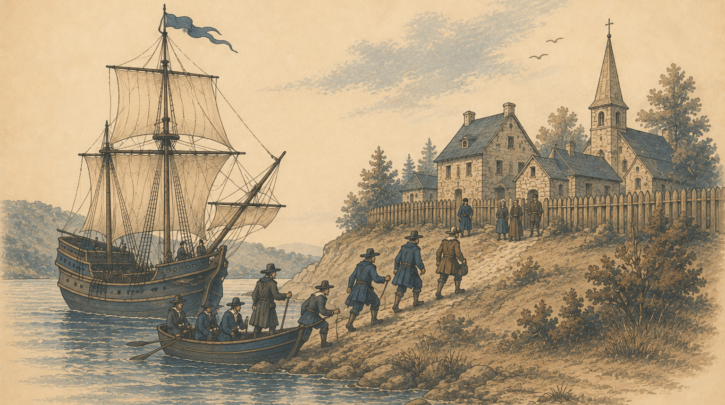

Behind every French-Canadian family tree stands a remarkable fact: the millions of people of French-Canadian descent alive today trace back to fewer than ten thousand immigrants who crossed the Atlantic to settle New France in the seventeenth and early eighteenth centuries. Genealogists call these founding settlers the pioneers, and identifying your own—the first ancestor on a given line to step off a ship from France—is the central quest of French-Canadian research. This guide explains who they were, why finding them is so achievable, and exactly how to do it.
Why this is one of genealogy’s great success stories
In most parts of the world, tracing a family back to a specific seventeenth-century immigrant is a fantasy. In French Canada it is routine. The reason is the combination we explore throughout this site: nearly complete Catholic parish registers from 1621, a tradition of notarial records that documented marriages and estates, and generations of scholars who indexed and reconstructed it all. Because a marriage record names both spouses’ parents, you can climb the tree one marriage at a time until you reach an ancestor who was born not in the colony but in France. That ancestor is your first immigrant.
Not sure where to start with your French-Canadian ancestry?
Get the French-Canadian Genealogy Quick-Start Checklist — a 6-step path to your first real ancestor record, plus the surname quirk that trips up almost every beginner.
Who the immigrants were
The founders did not arrive as one undifferentiated wave. They came in recognizable groups, and knowing which group your ancestor belonged to often unlocks a wealth of existing research:
- Habitants and engagés. The backbone of the colony: ordinary settlers and indentured laborers (the trente-six mois, contracted for three years) who came to farm and stayed to build families.
- The Filles du Roi. About 770 women sent under royal sponsorship between 1663 and 1673 to marry settlers and grow the population. A large share of French-Canadians descend from at least one.
- Soldiers of the Carignan-Salières Regiment. Roughly 1,200 troops who arrived in 1665; several hundred remained as settlers when the regiment was recalled.
- Religious, merchants, and officials. Smaller in number but well documented, from missionaries to seigneurs to colonial administrators.
Step one: work backward to the immigrant
You do not search for the immigrant directly—you arrive at them by climbing. If you have not yet built the chain, start with our step-by-step guide to tracing French-Canadian ancestry, which walks from your living relatives back through the registers. The engine is the marriage record: each one names the parents of the bride and groom, handing you the previous generation. Repeat it, generation after generation, and eventually a record will describe an ancestor as born in France—“natif de” a French parish, or “of the kingdom of France.” You have reached the immigrant.
Identifying your immigrant ancestor is a records job: work back through marriages on Généalogie Québec and PRDH-IGD until you reach the one born in France, then use the free Fichier Origine via BAnQ to pin down the French parish.
Step two: confirm with the pioneer dictionaries
You are almost never the first person to research a New France pioneer. Scholars have compiled the founding population into reference works that can confirm your line and fill in details:
- René Jétté’s Dictionnaire généalogique des familles du Québec (origins to 1730) is the standard scholarly reference for the founding families.
- PRDH-IGD reconstructs the same families with linked records, ideal for verifying each generation.
- Cyprien Tanguay’s older dictionary remains useful despite known errors, especially as a finding aid.
Treat these as evidence to verify against the original Drouin images, not as the last word—but they will save you enormous effort and often confirm a connection in minutes.
Step three: find where in France they came from
Once you have your immigrant, the natural next question is where in France they were born. The free Fichier Origine database identifies the European origins of thousands of New France pioneers and links them to their birth parish. Most came from the northwest—Normandy, Perche, Poitou, Aunis, and the Île-de-France—a pattern we map in our guide to where French-Canadians came from. From there, continuing into French records is a separate challenge covered in tracing your ancestry back to France.
A note on Acadian lines
If your founding ancestor settled in Acadia rather than along the St. Lawrence, the path differs. Acadian pioneers are documented in their own reconstructed dictionaries, and the deportation of 1755 complicates research dramatically. Start instead with our Acadian genealogy guide.
Does descent from a French pioneer make you French?
It is a common and reasonable question: if your ancestor was born in France, are you eligible for French citizenship? In almost all cases, no. French nationality by descent does not reach back across so many generations to a seventeenth-century emigrant; the line is far too distant. (Canadian citizenship by descent is a different matter and may apply through a more recent Canadian-born ancestor.) We cover this honestly in our citizenship section.
Recommended reading (available on Amazon):
- Dictionnaire généalogique des familles du Québec (René Jétté)
- French-Canadian Sources: A Guide for Genealogists
- A Genealogist’s Handbook for French-Canadian Research
Frequently asked questions
How many immigrant ancestors will I have?
Many. You descend from a pioneer on essentially every line of your tree, so a typical French-Canadian has hundreds of distinct founding ancestors once you go back far enough—Filles du Roi, soldiers, habitants, and more.
Is it really possible to trace every line to France?
Most lines reach a named immigrant, and many can be tied to a French parish through Fichier Origine. Continuing inside France is harder and depends on which French records survive.
What proves an ancestor was the immigrant
How do you know a given ancestor is the one who crossed, rather than a colony-born child of an earlier immigrant? The records tell you. Look for an explicit statement of French birth—a marriage record or marriage contract describing the person as natif de a named French parish, or “of the kingdom of France”—and for the absence of a Canadian baptism. When you find a marriage in the colony but no corresponding baptism in any Québec parish, and the record points to a French origin, you have very likely found your immigrant.
A worked example
Suppose your line reaches a man marrying in 1668. His marriage record names his parents and states he is from a parish in Normandy. You search the Québec registers for his baptism and find none—because he was baptized in France. PRDH-IGD confirms he has no Canadian birth record and links him to that 1668 marriage as a founder. Fichier Origine lists his Norman parish. In four steps you have identified the immigrant, confirmed he is the immigrant, and located his birthplace—the whole arc of this kind of research in miniature.
Frequently asked questions
What’s the difference between a pioneer and a first immigrant ancestor?
They’re essentially the same idea: a pioneer (or founder) is any immigrant who settled New France and left descendants; your first immigrant ancestor on a given line is the specific pioneer that line climbs back to.
Do I need to find all of them?
Not at all. Most people start by tracing a few surnames of interest to their immigrants, then expand. Because you have a pioneer on every line, the project can be as small or as sprawling as you like.