
Open your DNA results for the first time as a French-Canadian descendant and your reaction is usually the same: this can’t be right. The match list runs to thousands of people. Dozens are labeled “2nd–4th cousin.” Names you’ve never heard of appear to share more DNA with you than your actual second cousin does. It looks like a glitch — but it isn’t. It’s the single most important thing to understand about French-Canadian DNA, and it traces back to one number.
That number is roughly 8,500 — and once you understand it, you’ll stop asking “which test has the most features?” and start asking the only question that matters for French-Canadian roots: which test gives me the tools to survive an overwhelming match list? This guide answers that — but it explains the phenomenon first, because the phenomenon is what should decide your choice.
The one number that explains your whole match list: 8,500
Millions of people alive today have French-Canadian ancestry. Demographic research on the Québec population — most notably the work built on the BALSAC population database and the PRDH — has shown that essentially all of them descend from a founding pool of only about 8,500 settlers who put down roots in New France and left descendants. Not 8,500 per region or per generation: roughly 8,500 people, in total, are the genetic source of the entire French-Canadian population.
Those founders — the Filles du Roi, the soldiers of the Carignan-Salières Regiment, and the habitant families who arrived mostly in the 1600s — then multiplied enormously over four centuries, with very little new DNA entering the pool from outside. A small founding group, very large families, and centuries of marrying within the same community: that is the recipe for what geneticists call the founder effect, and it is why your results look nothing like a typical tester’s.
Not sure where to start with your French-Canadian ancestry?
Get the French-Canadian Genealogy Quick-Start Checklist — a 6-step path to your first real ancestor record, plus the surname quirk that trips up almost every beginner.
The founder effect: why you have thousands of “cousins”
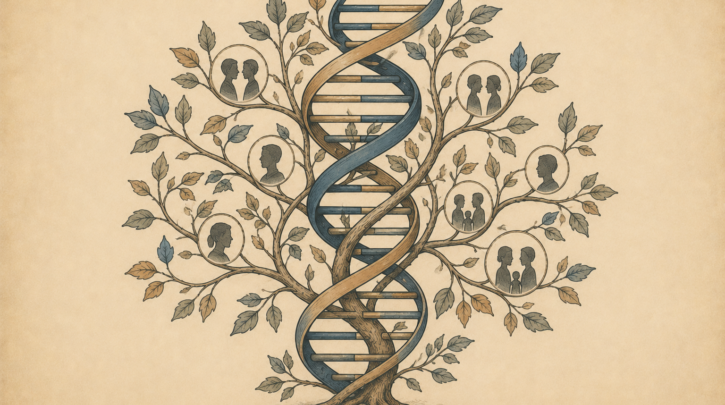
When everyone descends from the same small pool, the same ancestral couples appear over and over in a single family tree — a phenomenon called pedigree collapse. You are not related to another French-Canadian descendant through one common ancestor; you are related through dozens or even hundreds of separate paths at once. Each of those distant connections can leave a small trace of shared DNA, and those traces pile up.
Compare two testers. Someone whose grandparents each arrived recently from a large country will have a sparse match list — a few close relatives, then mostly strangers. A French-Canadian descendant testing on the same platform may see a list many times longer, dense with distant cousins who all trace back to that shared founding pool. This is endogamy, and it is the defining feature of French-Canadian genetic genealogy. (For the technical background, the ISOGG wiki’s endogamy page is the standard reference.)
Why the centimorgan estimates lie to you
DNA companies estimate how you’re related to a match by measuring the total amount of DNA you share, in units called centimorgans (cM). More shared cM normally means a closer relationship, and the tools convert the total into a predicted cousinship using crowdsourced averages like the widely used Shared cM Project.
Here’s the problem: those averages assume you and your match are related one way. In an endogamous population you’re related many ways, so the small amounts of DNA you share across all those distant lines add up to a total that looks like a single close relationship. The result is that the relationship prediction runs misleadingly close. A match the tool confidently labels a “3rd–4th cousin” may in reality be a 6th cousin several times over. The cM total is real; the interpretation is wrong. For French-Canadian matches, treat every predicted relationship as “no closer than this — and probably a good deal more distant.”
So “which test is best?” is the wrong question
Most DNA-test comparisons hand you a spec checklist: markers tested, ethnicity regions, database size. For French-Canadian ancestry, that checklist mostly misses the point. Your problem won’t be too few matches or too little detail — it will be a flood of thousands of distant, tangled, misleadingly-labeled matches. So the deciding factor is not what a test measures. It’s whether the platform gives you the tools to sort, group, and filter an overwhelming match list down to the handful of connections you can actually document.
That single reframe changes the recommendation. Judge the tests by their match-management toolkit, not their feature sheet.
The tools that tame an endogamous match list
These are the features that actually matter when your match list has five digits. As you weigh the companies below, look for these — not for the biggest ethnicity map.
| Tool | What it does | Why it matters with endogamy |
|---|---|---|
| Shared matches (in-common-with) | Shows who you and a match both match | Clusters your list into family branches |
| Auto-clustering | Groups matches who all match each other | Isolates one lineage out of the noise automatically |
| Custom groups / colored labels | Tag matches by branch by hand | Lets you sort thousands of matches over time |
| Tree + ThruLines / Theory | Proposes the common ancestor | A head start — but verify against records |
| Chromosome browser | Shows the exact shared segments | Distinguishes a real shared line from a pile-up |
The recommendation, reframed around the flood
AncestryDNA — take this first
AncestryDNA earns the first slot on two grounds that both matter for the flood. First, its database is by far the largest, so the specific cousin who holds the photo or the missing maiden name is most likely to be in it. Second, its sorting tools are strong: shared matches plus up to two dozen custom colored groups let you tag matches by branch, and ThruLines proposes how a match connects through your tree (treat its suggestions as hypotheses — endogamy fools it). It also sits on the platform that hosts the Drouin Collection, so you can jump from a match straight to the parish record that proves the link. Its one real gap for endogamy work: no chromosome browser, so segment-level triage has to happen elsewhere.
MyHeritage — the endogamy-management complement
MyHeritage fills Ancestry’s gaps for exactly this problem. It offers built-in AutoClusters (it emails you a color-coded chart grouping your matches into likely family lines), a chromosome browser for segment triage, and Theory of Family Relativity to propose connections. Best of all, it accepts free uploads of your raw DNA file from other companies — so you can test once at Ancestry and add MyHeritage’s clustering and chromosome tools for nothing. Its more international user base also helps if your living cousins are in France. For most French-Canadian researchers, “AncestryDNA plus a free MyHeritage upload” is the most complete toolkit available. Our AncestryDNA vs. MyHeritage comparison goes deeper.
23andMe — weakest for this job, with a caveat
For managing a French-Canadian match flood, 23andMe is the weakest of the group: it has a smaller database, no real tree-building, and no integration with Québec records. It also comes with a caveat worth knowing — 23andMe filed for Chapter 11 bankruptcy in 2025 and was acquired by the nonprofit TTAM Research Institute (led by co-founder Anne Wojcicki), which now operates it; the episode drew privacy scrutiny from a coalition of U.S. state attorneys general that has continued into 2026. It’s a reasonable choice if health and traits are your main interest, but read the current privacy terms, know you can request deletion, and don’t expect it to be your best tool for sorting cousins.
FamilyTreeDNA — the escape hatch for a single line
There is one way to sidestep the autosomal flood entirely: test a single line directly. FamilyTreeDNA alone offers Y-DNA (the strict paternal line) and mtDNA (the strict maternal line), which aren’t scrambled by endogamy the way autosomal matching is. If your question is whether two families sharing a surname like Tremblay or Gagnon descend from the same founder — the kind of surname-line work tangled up with dit names — a Y-DNA test on a male-line descendant of each answers it cleanly where autosomal DNA can’t. It also accepts free autosomal uploads.
Ready to test? Our French-Canadian DNA hub has current kit links and discount windows for AncestryDNA, MyHeritage, and the others, plus step-by-step setup help for each — so you can put the right match-management tools to work from day one.
How to actually work the flood
Whatever kit you choose, the method for an endogamous match list is the same — and it always ends at the records:
- Build a tree first. Attach at least four or five generations before your results arrive, keep it public, and put it on the platform you test on — that is what powers ThruLines and Theory of Family Relativity.
- Start with your closest matches. The more DNA you share, the more likely a single recent ancestor explains it — and the easier it is to document.
- Cluster, don’t scroll. Use shared matches, AutoClusters, or the manual Leeds Method (sorting matches into colored groups by which of them match each other) to break the flood into branches.
- Anchor each cluster to a documented couple. This is the French-Canadian superpower: because the PRDH reconstructions and parish records are so complete, you can often name the exact ancestral couple a cluster shares — see connecting DNA to Québec records.
- Ignore the distant thousands. Focus on the matches you can document and let the rest sit as background noise.
The bottom line
The 8,500 founders are why your match list is overwhelming, why your cousin estimates read too close, and why the “best” DNA test is simply the one that helps you sort the flood. In practice that means AncestryDNA for its database, colored groups, shared matches, and records integration, complemented by a free MyHeritage upload for clustering and a chromosome browser — with FamilyTreeDNA held in reserve for a specific surname line. But remember the deeper truth of French-Canadian research: DNA confirms, and the records prove. The documents can name the exact couple a match shares with you; the DNA only points. And for anything formal — citizenship by descent above all — DNA carries no weight at all; only certified records do. Test to find cousins and verify links, then turn to the paper trail to know. Start with our step-by-step guide to build the tree your results will slot into.
Frequently asked questions
Why do I have thousands of DNA matches?
Because French-Canadians descend from a founding pool of only about 8,500 settlers. The resulting founder effect and endogamy mean you connect to other descendants through many lines at once, producing a match list many times larger than a typical tester’s.
Why does DNA say a match is a closer cousin than they really are?
Endogamy inflates shared centimorgans, because you share small segments across several distant common ancestors at once. Relationship estimators are built on single-relationship averages, so they read that inflated total as a closer cousinship. Treat every French-Canadian prediction as “no closer than this, and probably more distant.”
Which DNA test is best for French-Canadian ancestry?
AncestryDNA first, for its large database, colored custom groups, shared matches, and Drouin records integration — then upload your raw data free to MyHeritage for AutoClusters and a chromosome browser. Use FamilyTreeDNA for a specific Y-DNA or mtDNA surname line. Choose based on match-management tools, not spec sheets.