
Ask experienced French-Canadian genealogists which single resource they would keep if they could keep only one, and a large share will name the PRDH-IGD. It is not the cheapest database, nor the prettiest, but for the founding centuries of New France nothing else comes close to its accuracy or its reconstructions. This guide explains exactly what it is, what it covers, and how to get the most out of every search.
What PRDH-IGD actually is
PRDH stands for Programme de recherche en démographie historique, a demographic research program at the Université de Montréal that has spent decades reconstructing the population of early Québec. IGD—Infrastructure intégrée des microdonnées historiques—is the integrated platform that delivers it online. In practice, people use “PRDH-IGD” to mean the searchable database at prdh-igd.com.
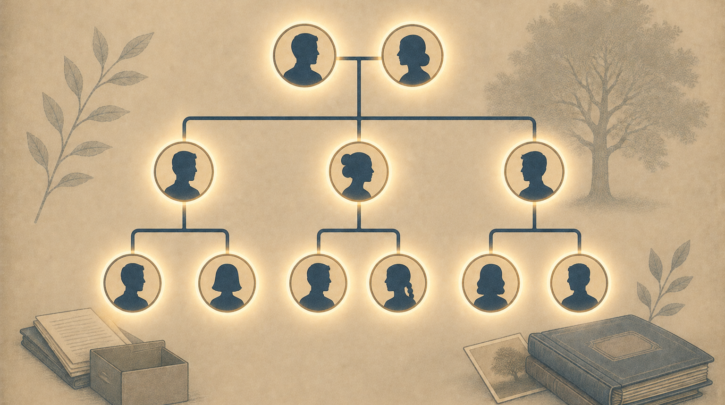
Its defining feature is that it does not just index records; it links them. Scholars matched baptisms, marriages, and burials into family files, so a single search can show you a couple, their marriage, every child they baptized, and the dates each one died.
Not sure where to start with your French-Canadian ancestry?
Get the French-Canadian Genealogy Quick-Start Checklist — a 6-step path to your first real ancestor record, plus the surname quirk that trips up almost every beginner.
What it covers
- Every Catholic record in Québec from 1621 to 1849—baptisms, marriages, and burials, indexed from the parish registers.
- Family reconstructions that link individuals across records into couples and households.
- Marriage repertories extending later, useful for tracing into the nineteenth century.
- Cross-references that flag when the same person appears in multiple events.
The 1621–1849 window is the key number to remember. For anything in that range, PRDH is your first stop. After 1849 you will lean more on the Drouin Collection, LAFRANCE and BMS2000, and civil registration.
Why the reconstructions matter
A plain index tells you that a baptism happened. A reconstruction tells you how that baptism fits into a family. When you open a PRDH “individual” or “couple” file, you see the person’s parents, spouse, siblings, and children assembled in one place, each linked to its source record. This is what lets you climb generations quickly and confidently—and it is what catches errors, because an impossible date or a duplicated child stands out immediately.
For the seventeenth century in particular, where names repeat and records are sparse, these reconstructions routinely solve problems that would take days of manual cross-checking elsewhere.
How a subscription works
PRDH-IGD is a paid subscription. It is typically sold as access for a set number of days, or as a block of “hits” (record views), so you can choose between a short intensive research sprint or a longer subscription. Searching is generally free; you pay to open the detailed records and reconstructions. Pricing changes over time, so check the current rates on the site before you buy, and plan your searches in advance so you are not paying for trial-and-error.
Tip: pair PRDH with a Généalogie Québec subscription. PRDH gives you the reconstructed family tree; Généalogie Québec’s Drouin images let you read the original record behind each index entry. Together they cover the gap between “what the index says” and “what the priest actually wrote.”
How to search effectively
- Search the marriage first. A marriage record names both spouses’ parents, so it is the most information-dense entry. Find the marriage and you have found the previous generation.
- Use date ranges, not exact dates. Early dates are approximate; give yourself a window.
- Try spelling variants. Names were spelled phonetically. Lavigne, Lavergne, and similar variants can all hide the same family.
- Mind the dit names. Many families carried a second surname (a dit name); a person indexed under one may appear under the other.
- Follow the links. Once you open a reconstruction, click through parents and children rather than running fresh searches—it is faster and uses fewer credits.
PRDH versus the alternatives
PRDH-IGD overlaps with other databases but is not replaced by them. LAFRANCE (on Généalogie Québec) is excellent and includes images; BMS2000 is a strong collaborative index. But PRDH’s scholarly reconstructions for 1621–1849 remain its edge. The professional workflow is to use all three, treating disagreements between them as a signal to look at the original register yourself.
Common mistakes to avoid
- Treating a reconstruction as gospel without checking the underlying record—reconstructions are excellent but not infallible.
- Burning credits on broad searches; narrow your terms first.
- Ignoring burials—a burial record can confirm a death date that resolves which of two same-named people you are looking at.
Used well, PRDH-IGD turns the early generations of a French-Canadian tree—the part most genealogists dread—into the easiest part of the whole project. For the bigger picture of how it fits with everything else, return to our step-by-step guide to tracing French-Canadian ancestry.
What PRDH-IGD will not do
PRDH is superb within its lane, but know its edges. Its reconstructed coverage centers on 1621–1849; for later nineteenth- and twentieth-century research you will rely more on LAFRANCE and BMS2000 and civil registration. It indexes Catholic records, so non-Catholic and civil-only events fall outside it. And while the reconstructions are meticulous, they are scholarly interpretations—when one conflicts with the original Drouin image, the document wins.
A sample search, start to finish
- You know a couple married around 1740 in the Québec City area. Search PRDH’s marriage index for the surnames with a date range of 1735–1745.
- Open the marriage record: it names both spouses’ parents. You now have the previous generation on both lines.
- Click through to each parent’s own reconstruction to find their marriage—and so the generation before that.
- Spot-check one record against the Drouin image on Généalogie Québec to confirm the reading before you build further.
Two or three iterations of this loop routinely move a line back a century in an evening—something that is simply not possible in less complete record sets.
Frequently asked questions
Is PRDH-IGD in English?
The interface offers English, and the index fields (names, dates, places) are easy to use without French. The original records it points to are in French or Latin.
PRDH or Généalogie Québec—which first?
If you can only buy one and your research is mostly pre-1850, PRDH’s reconstructions are unmatched. If you want original images and a broader date range in one place, start with Généalogie Québec and add PRDH for the early generations. Most serious researchers end up with both.
How to read a PRDH reconstruction
When you open a PRDH “couple” (or “union”) file, you are looking at a small dossier: the husband and wife, their marriage with its date and place, each spouse’s parents, and a list of their children linked to their own baptisms and, where known, marriages and burials. An “individual” file centers on one person and shows the events and relationships attached to them. The power is in the links—every name is clickable, so you navigate the family tree by following relationships rather than running fresh searches. Read these files as evidence to verify, not facts to copy: glance at the source record behind any surprising link before you build on it, and you will catch the rare mismatch before it propagates up your tree.
The bottom line: for the founding centuries of New France, PRDH-IGD’s family reconstructions are the closest thing French-Canadian genealogy has to a cheat code. Use it to climb the early generations quickly and to keep same-named individuals from merging, then confirm against the original Drouin images as you go.