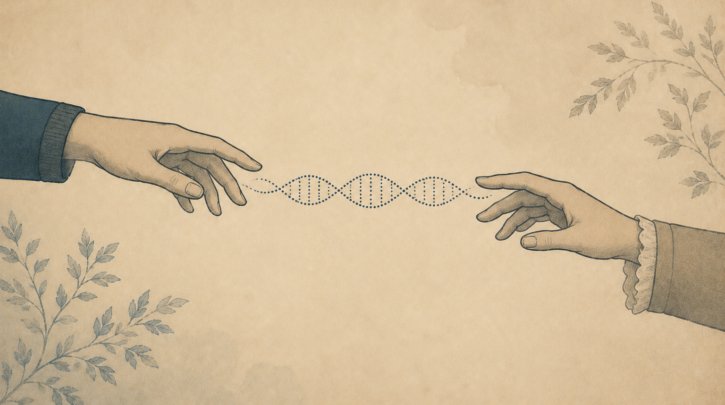

A DNA test is at its most rewarding when it stops being a list of strangers and becomes a way to meet actual relatives—the cousin in Trois-Rivières with the family photographs, the distant relation in Massachusetts who already traced the line you are stuck on. For French-Canadians the challenge is not finding matches; you will have thousands. The challenge is sorting a list that endogamy has made enormous and noisy, and then turning the right matches into a real connection. Here is a workflow that works.
Step 1: Test where the relatives are
You can only match people who are in the same database. Because most descendants of Québec families are in North America and AncestryDNA has the largest North American pool, that is where the bulk of your French-Canadian cousins will be. Test there first, then upload your raw file for free to MyHeritage to pick up anyone—particularly European relatives—who tested there instead. We keep current links for both on the DNA hub.
Not sure where to start with your French-Canadian ancestry?
Get the French-Canadian Genealogy Quick-Start Checklist — a 6-step path to your first real ancestor record, plus the surname quirk that trips up almost every beginner.
Step 2: Triage your match list
Do not try to process thousands of matches. Work from the top down, because closeness is reliability:
- Close matches (1st–2nd cousins): trustworthy even in an endogamous population. Start here—these are the people most likely to share living memory and documents.
- Mid-range matches: where endogamy inflates the numbers most. Useful, but do not trust the predicted relationship; verify in the records.
- Distant matches: mostly background relatedness. Skim for surnames and shared ancestors, but do not invest heavily.
Most platforms let you sort by shared DNA, label matches with coloured groups or dots, and add notes. Use all three from day one. A tidy, annotated match list is the difference between a tool and a haystack.
Step 3: Read the trees and shared surnames
For each promising match, look at whether they have a tree and what surnames appear in it. French-Canadian surnames—often with their dit names attached—are your quickest clue. If you both have Gauthier dit Larouche from the same parish, you have a hypothesis. The shared-surname tools on Ancestry and MyHeritage automate part of this, but reading the trees yourself catches links the software misses, especially where a dit name or an anglicized spelling has obscured the connection.
Step 4: Use clustering and shared matches
The “shared matches” feature—people who match both you and a given relative—is your best weapon against endogamy. Matches who cluster together usually descend from the same branch of your tree. If a group of your matches all also match each other and several have a particular founding couple in their trees, that branch is almost certainly the source. You are using the shape of the match network to do what a single inflated cM total cannot.
Step 5: Anchor it in the records before you believe it
This is the step that separates sound genealogy from a tangle of guesses. Once you have a hypothesis—“this match and I both descend from this couple”—prove each line in the documents. Trace your own descent and theirs through the Drouin parish records and confirm the index entries in PRDH. Only when both lines are documented should the connection go into your tree as fact. The full method is in connecting DNA to Québec records.
Step 6: Reach out—the right way
A good first message gets a reply; a vague one gets ignored. When you contact a match:
- Be specific. Name the likely common ancestor or shared surname and parish. “I think we both descend from Jean Crête and Marie-Anne, married at Champlain” beats “Hi, we’re a match.”
- Offer before you ask. Share what you already know—a documented line, a photo, a record. People respond to generosity.
- Keep it short and warm. One paragraph, a clear question, an easy way to reply.
- Be patient and kind. Many testers are not active genealogists. A non-reply is rarely personal.
What DNA matches can give you
Handled well, your match list yields things no database can: a cousin’s photographs and letters, an oral history that fills a gap in the records, a branch someone else has already documented, and occasionally the resolution of a genuine mystery—an unknown great-grandparent, a hidden adoption, a line you could not otherwise crack. Combined with the depth of French-Canadian records, a well-worked match list turns a tree on a screen into a living, connected family.
Test on the platform with the most French-Canadian cousins and the best sorting tools—see the options on our DNA hub—then verify every match against the registers using our records workflow.
Organising the work so it does not overwhelm you
The single biggest reason people give up on their match list is volume: thousands of names, no system, no progress. Impose structure early. Pick one branch of your family to work on at a time rather than the whole tree at once. Use the platform’s coloured-dot or group labels to tag matches by the branch they belong to as you identify them. Add a short note to every match you investigate—even just “Bourbeau line, Yamaska, confirmed”—so you never redo the same detective work twice.
Working one branch at a time also plays to the strength of shared-match clustering: as you confirm a few matches on, say, your maternal grandmother’s line, their shared matches light up the rest of that branch for you. Progress compounds. A match list that felt like an undifferentiated wall becomes a set of labelled, navigable family groups—and that is when finding new relatives starts to feel less like luck and more like method.
Managing expectations about who responds
Be realistic about the people on the other end. Many took a DNA test out of curiosity about ethnicity and have never logged back in; others are private, busy, or simply not genealogists. A reasonable reply rate even to good, specific messages is modest, so cast a wide net, lead with your closest and most active-looking matches, and treat every reply as a bonus rather than an entitlement. The cousins who do engage—often the ones who already share a founding couple in their tree—are frequently the most generous collaborators you will find anywhere in French-Canadian research.
Turning a confirmed cousin into a research partner
The real prize at the end of this workflow is not a name on a match list but a collaborator. Once you have confirmed a relationship in the records and exchanged a few friendly messages, a French-Canadian cousin can become one of the most valuable assets in your research—because they often hold exactly the things the registers do not. Photographs, letters, a grandmother’s handwritten family record, oral histories about why the family left for the New England mill towns, or simply a branch of the tree they have already documented that dovetails with yours.
Approach these relationships as a two-way exchange and they tend to flourish. Offer your documented lines, your record images, and your own family stories before asking for theirs. Keep a shared note of what each of you has worked out, so the collaboration builds rather than repeats. Over time a handful of engaged cousins, each working a different branch, can extend a tree faster and further than any amount of solo searching—and they turn the abstract fact of shared DNA into the thing most people actually wanted from the test: a living connection to a family they had only read about in records.