
Knowing that your surname means “baker” or comes from the Perche is satisfying, but the real goal of surname research is to connect the name to a person: the immigrant founder who first carried it across the Atlantic, and the French parish they came from. Because so many French-Canadian names descend from a single ancestor, this is a realistic goal. Here is the method, step by step.
Step 1: Trace the name back through the records
Surname research is genealogy, not etymology—you find the origin by climbing the tree, not by looking the name up in a book. Work backward from yourself through marriages, as in our step-by-step guide, following the surname generation by generation toward the seventeenth century. The marriage records, which name parents on both sides, are the rungs of the ladder.
Every surname question is ultimately a records question: to find your name’s founder and meaning you trace it back through the registers. The Drouin images and LAFRANCE index are bundled at Généalogie Québec; the same Drouin records are on Ancestry, with MyHeritage useful for matching trees. Our records guide compares them.
Not sure where to start with your French-Canadian ancestry?
Get the French-Canadian Genealogy Quick-Start Checklist — a 6-step path to your first real ancestor record, plus the surname quirk that trips up almost every beginner.
Step 2: Account for dit names, variants, and anglicization
As you climb, the name will change shape, and you must follow it through every transformation or you will lose the line:
- Watch for spelling variants—search every form, not just the modern one.
- Test for a dit name whenever the line stalls; the family may simply be recorded under its other surname.
- If your family is Franco-American, expect anglicization near the border and trace the name back to its French form.
Step 3: Identify the founder
As the line approaches the founding era, the pioneer dictionaries (Jétté, PRDH) can confirm the immigrant who introduced the surname. For many names this is a single, well-documented person; for nickname-based names like Roy, you may find that your line traces to one of several independent founders, so confirm which founder is yours rather than assuming.
Step 4: Find the French origin
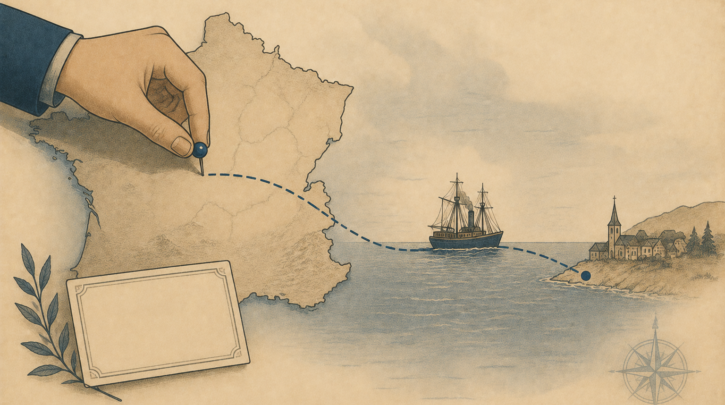
Once you have the founder, the free Fichier Origine database (via BAnQ) often supplies their birth parish in France—usually in the northwestern regions most New France immigrants came from. This is where your surname truly originates: a specific place in France, where the name may still survive today. Continuing into French records follows our guide to tracing your ancestry back to France.
Step 5: Confirm with Y-DNA where it helps
Paper sometimes runs out or tangles—especially when dit names and variants make it unclear whether two same-surname lines connect. This is the one place DNA earns a role in surname work. Because a surname passes down the paternal line, a Y-DNA test traces that same male line and can show whether two men sharing a surname share a direct paternal ancestor. Surname-based Y-DNA projects are designed for exactly this question.
When dit names and spelling changes tangle a paternal line, Y-DNA can cut through it: a Y-DNA test (FamilyTreeDNA runs the surname projects best suited to this) shows whether two same-surname lines actually share a direct paternal ancestor. It’s a niche, paternal-line tool—see our DNA guide for where it fits.
Keep DNA in perspective, though: it confirms or refutes a connection, but it does not replace the records that build the actual tree, and French-Canadian endogamy means results need careful reading. For most surnames, the paper trail does the work and Y-DNA is the tiebreaker.
The payoff
Done properly, surname research delivers something genealogy rarely offers so cleanly: a straight line from your modern family name to a specific seventeenth-century person and a specific French village. For a name like Tremblay or many others, that line is shared with vast numbers of people—which is part of what makes French-Canadian genealogy feel like one immense family reunion.
Recommended reading (available on Amazon):
- Dictionnaire généalogique des familles du Québec (René Jétté)
- French-Canadian Surnames: Aliases, Adulterations and Anglicizations (Robert J. Quintin)
Frequently asked questions
Can I find my surname’s origin just by looking it up?
A dictionary gives the likely meaning, but the origin—your specific founder and their French parish—comes only from tracing your own line through the records. Two families with the same name can have different founders.
Is a DNA test necessary for surname research?
Usually no. The records carry most surname research on their own. Y-DNA is a specialized tiebreaker for paternal-line questions when dit names or variants leave the paper trail ambiguous.
A complete worked example
Suppose your surname is “Pelkey” in New Hampshire. You trace the family back through U.S. censuses and a French national parish, where the name appears as Pelletier—an anglicization resolved. The Québec registers carry Pelletier back through the generations; along the way you note a couple of spelling variants and check for a dit name. The pioneer dictionaries identify the founding Pelletier immigrant, and Fichier Origine names his parish in France. In five linked steps, “Pelkey, New Hampshire” has become “Pelletier, born in a specific French village in the 1600s.” That is what successful surname research looks like.
Common mistakes to avoid
- Looking the name up instead of tracing it. A dictionary gives a meaning, not your founder. Two families with one name can have different origins.
- Locking onto one spelling. You will miss records; search every variant.
- Forgetting dit names. A stalled line is a dit name until proven otherwise.
- Trusting an unsourced online tree that asserts a founder without records. Verify every generation against the originals.
- Over-relying on DNA. Y-DNA confirms connections; it does not build the tree.
A quick tools checklist
- Généalogie Québec (LAFRANCE + Drouin images) and PRDH-IGD for tracing and confirming the line.
- BAnQ and Fichier Origine (free) for original records and the French origin.
- A surname/dit-name dictionary for meanings and known dit names.
- A Y-DNA surname project as a paternal-line tiebreaker.
When the trail ends
Sometimes surname research stops short of the clean founder-and-village result. The immigrant’s French origin may never have been recorded, the relevant French parish registers may not survive, or two equally plausible founders may remain impossible to separate on paper. When that happens, document exactly where the evidence runs out and why, rather than papering over the gap with a guess. A surname traced honestly to “a specific immigrant of uncertain French origin” is a real and respectable result; a surname traced confidently to the wrong founder is worse than no answer at all.
The bottom line: researching a French-Canadian surname is genealogy with a particularly satisfying destination. Because the names so often descend from a single founder, the work tends to converge rather than sprawl—climbing the line, clearing the dit names and variants, confirming the founder, and reaching for a French parish. Start from yourself, follow the name through every disguise it wears, and let the records carry you back to the person who first carried it across the Atlantic.