

It is one of the most common questions in genealogy circles right now: am I a Canadian citizen without knowing it? Since Bill C-3 removed the long-standing first-generation limit, a great many people—especially those with Canadian-born ancestors a few generations back—are asking it for good reason. This article is a plain-language self-assessment to help you see whether your situation is worth investigating. It cannot tell you for certain whether you are a citizen; only IRCC can do that. But it can tell you whether to look closer.
Important: This article is general information, not legal advice, and we are not lawyers. Canadian citizenship rules changed recently and remain in flux—the documentary standard was tightened during a review in June 2026—and eligibility is determined individually by Immigration, Refugees and Citizenship Canada (IRCC). Always confirm the current rules on the official canada.ca website, and consult a licensed Canadian immigration lawyer or a Regulated Canadian Immigration Consultant (RCIC) about your own situation.
Start with one question: when were you born?
Under the rules in force since December 15, 2025, your date of birth sorts you into one of two paths:
- Born before December 15, 2025. With the first-generation limit removed, you may already be a Canadian citizen if there is an unbroken chain of citizenship from a Canadian “anchor” ancestor down to you—and there is no residency requirement to meet. For people researching their roots, this is the usual case.
- Born on or after December 15, 2025. A “substantial connection” test applies: a Canadian parent who was themselves born abroad must have spent at least 1,095 days physically in Canada before your birth for citizenship to pass to you.
Not sure where to start with your French-Canadian ancestry?
Get the French-Canadian Genealogy Quick-Start Checklist — a 6-step path to your first real ancestor record, plus the surname quirk that trips up almost every beginner.
Then trace the chain
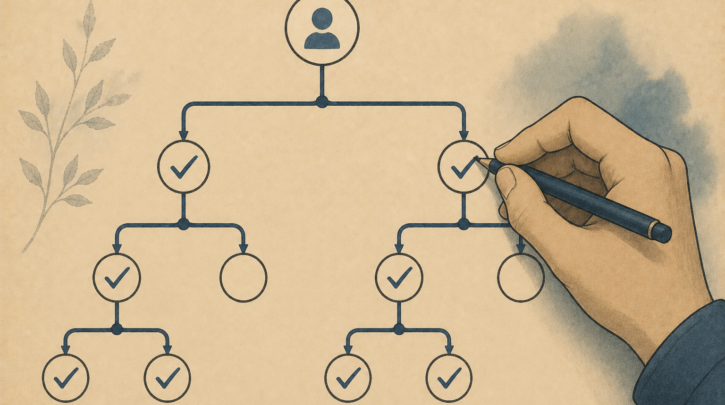
Citizenship by descent works like a relay: it passes hand to hand, generation to generation, and the chain must be unbroken. To assess your case, work backward and look for a Canadian “anchor”—an ancestor who was a Canadian citizen (born in Canada, or naturalized) and from whom citizenship could have flowed down to you:
- Identify your parents’, grandparents’, and great-grandparents’ birthplaces and citizenship.
- Look for the most recent ancestor who was born in Canada (or naturalized Canadian)—your likely anchor.
- Check that each generation in between actually held and could pass citizenship under the law as it stood at the time. (This is the technical part, and where a professional earns their fee.)
If your family is Franco-American, that Canadian-born anchor may be closer than you think—a great-grandparent born in a Québec parish before the family crossed into a New England mill town, for instance.
Common signals you should look closer
- You have a parent, grandparent, or great-grandparent born in Canada (very often in Québec).
- Your family emigrated from Canada to the United States within the last few generations.
- You already suspected Canadian ancestry but were told, before 2025, that the first-generation limit ruled you out—that barrier is precisely what Bill C-3 removed for those born before December 15, 2025.
None of these proves citizenship. Each is a reason to build the documented chain and, if it holds, to seek a professional opinion.
What a “yes” actually gets you
If you turn out to be a citizen by descent, you do not have to move to Canada, pass a test, or give up your existing citizenship as far as Canada is concerned. You apply for a proof-of-citizenship certificate to confirm and document the status, and from there you can obtain a Canadian passport. Be aware that holding two citizenships carries tax-filing and reporting obligations—especially for U.S. citizens—so factor in advice from a cross-border tax professional before celebrating.
The honest caveat
Eligibility by descent is genuinely individual and sometimes turns on fine points of historical citizenship law—retention rules, the status of a particular ancestor at a particular date, gaps in the record. A self-assessment like this is for deciding whether to investigate, not for reaching a conclusion. The June 2026 review, in which IRCC scrutinized the documentation behind recently issued certificates, is a reminder that a confident-looking online answer is no substitute for a properly built, properly sourced case reviewed by a qualified representative.
Frequently asked questions
Can I find out for free whether I’m a citizen?
You can assess your likelihood for free by tracing your line and reading canada.ca. The only authoritative determination comes from applying for a proof-of-citizenship certificate, which carries a government fee.
My ancestor left Canada a century ago—is it too late?
Not necessarily. For people born before December 15, 2025, Bill C-3 removed the generational cap, so an older Canadian-born anchor can still matter—provided the chain of citizenship between them and you is unbroken and documentable.
A worked example
Consider a common Franco-American pattern. Your great-grandfather was born in a Québec parish in 1905, moved to a Massachusetts mill town as a young man, and raised his family there; your grandmother, your parent, and you were all born in the United States. Before Bill C-3, the first-generation limit would have stopped citizenship at the first U.S.-born generation. After Bill C-3, because you were born before December 15, 2025, the cap is gone—so if the chain of citizenship from that Canadian-born great-grandfather is unbroken and documentable, you may be a citizen by descent. The whole question turns on documenting each link and confirming each ancestor’s status, which is precisely the genealogical work this site is about.
What can break the chain
A chain that looks solid can have hidden breaks, and recognizing them early saves disappointment:
- An ancestor who lost or renounced citizenship before the relevant birth can sever the line.
- Old “retention” rules. Under earlier laws, some people born abroad had to take active steps to keep their citizenship by a certain age or lose it—one of the quirks that created Lost Canadians in the first place.
- Documentation gaps. A missing record is not necessarily a legal break, but it must be addressed with acceptable alternative evidence and an explanation, as covered in documents for citizenship by descent.
Because these turn on the law as it stood at each ancestor’s birth, assessing them properly is where a licensed professional genuinely earns their fee. Use this self-check to decide whether to investigate; use an expert to decide whether you qualify.
The only authoritative answer
A self-assessment, a lawyer’s opinion, even a confident family story—none of these is a determination of citizenship. The only authoritative answer comes from IRCC, through a proof-of-citizenship (citizenship certificate) application, in which the department reviews your documented chain and confirms whether you are a citizen. Everything before that point is an informed estimate of whether applying is worthwhile. That is not a reason to hesitate if the signals are strong; it is a reason to build the case carefully before you file, since—as the June 2026 review underlined—the quality of your documentation is what the answer ultimately rests on. If your self-check suggests a real possibility, the productive next steps are to assemble the sourced records and obtain a professional opinion, then apply.