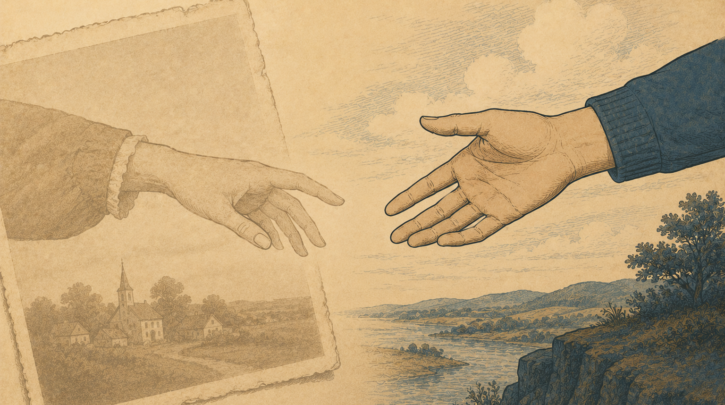

For a great many people—especially Franco-Americans whose families set the language and traditions aside a generation or two ago—genealogy is the beginning of something larger. Tracing the tree answers who your ancestors were; reclaiming your heritage is about carrying something of what they were into your own life. This is a guide to that fuller journey: from records to language, culture, living connection, and even, for some, a passport.
Start with the records—but don’t stop there
The foundation is knowing your family. Trace your line as far as the remarkable Québec records allow, using PRDH, the Drouin Collection and the methods in our guide to tracing French-Canadian ancestry. Few peoples can document themselves as completely; many Franco-descendants can follow a line unbroken to a founding immigrant of the 1600s. That knowledge is the root system everything else grows from.
But a tree on a screen is not yet a reclaimed heritage. The names become meaningful when you learn what their lives were like—the Filles du Roi who founded families, the habitant farmers on their riverfront rangs, the migrants who left for the New England mills. Reading the history turns ancestors into people.
Not sure where to start with your French-Canadian ancestry?
Get the French-Canadian Genealogy Quick-Start Checklist — a 6-step path to your first real ancestor record, plus the surname quirk that trips up almost every beginner.
Reclaim the language
Nothing reconnects you to French-Canadian heritage like the language your ancestors spoke. For families who lost their French in the push to assimilate—a story repeated in countless Franco-American households—learning it back can be profoundly moving. You need not become fluent to benefit: even modest French lets you read the old records yourself, speak with cousins in Québec, and take part in the culture from the inside rather than as a tourist.
Québécois and Acadian French have their own warm, distinctive character, different from the French of France, and leaning into that—through apps, classes, films, music, or conversation with relatives—is itself an act of reclamation. Many people find that the language, more than any document, is what finally makes the heritage feel like their own.
Reclaim the culture
Heritage lives in practice as much as in study. There are many ways to take part:
- The table — cook the dishes your family ate: tourtière at the holidays, pâté chinois, péa soup, sugar-pie, the foods of the cabane à sucre. Recipes are heritage you can share.
- The calendar — mark the days your ancestors kept: the Réveillon after Midnight Mass, the sugaring-off of spring, St-Jean-Baptiste Day on June 24 (Québec’s national holiday), and for Acadian families National Acadian Day on August 15.
- The music and stories — the fiddle and spoons, the chansons à répondre, the folk tales; a living tradition you can simply enjoy.
- The faith and festivals — whether or not you share the religion, the parish festivals and traditions were the rhythm of your ancestors’ year.
Reclaim the connections
Heritage is also people. A DNA test can put you in touch with living cousins—in Québec, the Maritimes, New England, Louisiana—who share your ancestors and often your enthusiasm. Because the French-Canadian population is so interconnected, you will find cousins easily; the joy is in turning a match into a relationship. And nothing roots heritage more firmly than standing together in the ancestral parish, which is why so many people pair the search for cousins with a heritage trip.
Find the living branches of your family: choose a test on our DNA hub and learn to turn matches into real connections with our matching guide.
Reclaim citizenship—for some
For a subset of Franco-descendants, reclaiming heritage can include something concrete: Canadian citizenship by descent. Recent changes to Canada’s citizenship law have, for many people with a Canadian parent or grandparent, reopened a path that was closed for years. Whether you qualify depends on the specifics of your family and the current rules, and the documentation required is exacting—the certified vital-records chain your genealogy already points toward.
Citizenship by descent is a legal matter with rules that have changed recently and may change again. Our articles on descent and whether you may already be a citizen explain the landscape, but this is informational only and not legal advice. Verify your situation against current government sources and consider consulting a licensed immigration professional. Note too that a claim to French citizenship through New France ancestry is, realistically, not available—a point we cover honestly.
A heritage worth the effort
To reclaim a French-Canadian heritage is to take up something that was, for many families, deliberately laid down—a language dropped to fit in, a culture quieted by a new country. Picking it back up, in whatever measure suits your life, is a quietly radical act of continuity: you become a link that holds rather than a link that breaks. Begin with the records, because they are extraordinary and they are yours. Then let them lead you outward—to the language, the table, the cousins, the parish, perhaps the passport—until the heritage is not just something you have researched, but something you live.
Wherever you are on the journey, start where it’s richest: trace your line with our ancestry guide and the tools on the records hub, then carry it into the world—a trip to Québec, a search for living cousins, or a look at citizenship.
Heritage at your own pace
It is worth saying plainly: reclaiming a heritage is not a test you pass or fail, and there is no single correct amount. Some people will learn French to fluency, travel to the ancestral parish, and pursue citizenship; others will cook a tourtière at Christmas, learn a handful of family stories, and feel entirely, rightly connected. Both are reclamation. The point is not to perform an identity to anyone else’s standard but to let your ancestry become a living part of your own life in whatever measure fits.
This matters especially for people who feel they have “lost too much” to begin—Franco-Americans whose grandparents stopped speaking French, whose surname was anglicized, who grew up with little sense of the heritage at all. None of that disqualifies you. The records are still there, the cousins are still there, the culture is still there, and the door is open at whatever point you choose to walk through it. A heritage interrupted in one generation can be taken up again in the next; that is, in fact, the most French-Canadian story of all.
Passing it on
The deepest form of reclamation is transmission—making sure what you have recovered does not stop with you. Share the documented tree with your children and cousins; cook the dishes with the next generation and tell them whose recipes they are; bring a young relative on the heritage trip; write down the stories before they are lost again. A family history is only as alive as its newest keeper. By becoming that keeper—and then handing the role onward—you turn a personal project of discovery into something that will outlast you, which is, when you think about it, exactly what your ancestors did for you.
Where to begin if you’re just starting
If all of this feels like a great deal, begin with one small, concrete step rather than the whole programme. Trace a single line back one or two generations further than you currently know—the immediate satisfaction of a confirmed great-great-grandparent is often the spark that lights the rest. Or cook one family dish, or learn ten words of French, or write to one DNA cousin. Heritage is reclaimed in increments, and each small recovery tends to suggest the next.
The resources on this site are arranged to support exactly that gradual journey: the research guides for the names and dates, the DNA hub for living cousins, the heritage-travel guides for the places, and the citizenship guide for those who want to pursue that path. Take them in whatever order your curiosity leads, at whatever pace your life allows. There is no finish line in reclaiming a heritage—only the steadily deepening sense that this long, resilient French-Canadian story is, after all, your own.