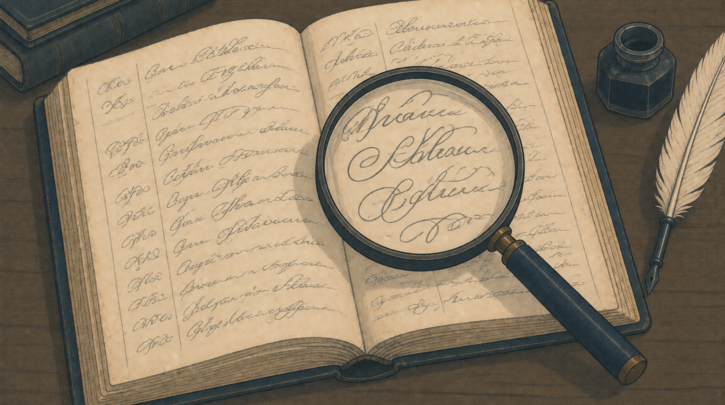

Sooner or later, every French-Canadian researcher faces the same moment: you find the right record, open the original image—and it looks like an unbroken wall of seventeenth-century cursive, half of it in Latin. Don’t close the tab. These records are far more readable than they appear, because they follow rigid formulas. Learn the formula and you can read the record even when you can’t read every letter.
Why the records are easier than they look
Priests didn’t write freely. A baptism, a marriage, and a burial each followed a standard template, repeated thousands of times with only the names and dates changing. Once you recognize the template, you know what each phrase must be saying, and you only have to decode the variable parts—the names, dates, and places you actually want.
Not sure where to start with your French-Canadian ancestry?
Get the French-Canadian Genealogy Quick-Start Checklist — a 6-step path to your first real ancestor record, plus the surname quirk that trips up almost every beginner.
Latin versus French
Earlier records (especially seventeenth- and early eighteenth-century baptisms and burials) are often in Latin; marriages and later records are more often in French. The good news is that the Latin is formulaic church Latin with a small, repeating vocabulary. A handful of words covers most of it:
- baptizavi — “I baptized”; natus/nata — born (male/female).
- filius/filia — son/daughter; conjugum — of the married couple.
- sepultus/sepulta — buried; defunctus/defuncta — deceased.
- patrinus/matrina — godfather/godmother.
In French records, the equivalents are baptême, né(e), fils/fille de, épouse/époux, inhumé(e), parrain/marraine. Memorize these two short lists and most of every record opens up.
Standard formulas to recognize
Baptism
A baptism typically reads: on [date], was baptized [name], born [date], son/daughter of [father] and [mother]; godfather [name], godmother [name]. Find fils/fille de (or Latin filius/filia) and the next two names are the parents—your previous generation.
Marriage
A marriage states the date, the groom (son of his parents, often with their living/deceased status), the bride (daughter of her parents), and the witnesses. Look for two instances of fils de / fille de: those four names are two complete sets of grandparents-to-be.
Burial
A burial gives the date, the deceased’s name, frequently an age, and sometimes the surviving spouse or parents. Watch for âgé de (“aged”) and veuve/veuf de (“widow/widower of”).
Handwriting and abbreviations
Old French paleography has a few quirks that trip up beginners:
- The long s (ſ) looks like an f without the crossbar—so “sépulture” can look like “fépulture.”
- Superscript abbreviations are everywhere: a small raised letter often means a dropped syllable.
- Letters like u/v and i/j were used interchangeably; “Iacques” is Jacques.
- Names were spelled phonetically and inconsistently—the same person may be spelled three ways across their own records.
Dating conventions
Most dates are written out in words and follow the modern calendar for the period you will research, but watch for records that reference a feast day or use Roman numerals. When a record gives a baptism date and a separate birth date, record both. And remember that early ages at burial are often approximate—treat “aged about 60” as a clue, not a fact.
A practical method
- Identify the record type from its position and opening words.
- Locate the fils/fille de (or filius/filia) phrase and extract the parents.
- Pull the date, the principal name, and the witnesses or godparents.
- Compare against the index transcription—if they disagree, trust the original but note the conflict.
- When truly stuck on a word, read the records on either side; the same hand and the same formulas make neighbors easier and build your eye.
You don’t have to learn this in a vacuum. A Généalogie Québec subscription pairs each indexed entry with the original Drouin image, so you can check your reading against a transcription every time—the fastest way to train your eye on real French-Canadian script.
Keep a cheat sheet
Build a one-page list of the Latin and French terms above, plus the spelling variants you encounter for your own surnames, and keep it beside you. Within a few sessions the formulas become second nature, and the registers stop being an obstacle and start being the most reliable evidence you have. For where this skill fits in the overall process, see the step-by-step ancestry guide, and for tricky surnames, our guide to French-Canadian surname origins and dit names.
Recommended reading. A few standards worth keeping on the desk (all available on Amazon):
- A Genealogist’s Handbook for French-Canadian Research
- French-Canadian Sources: A Guide for Genealogists
A worked example
Suppose a Latin baptism opens with a date, then baptizavi [name], filium [father] et [mother] conjugum. Translated formulaically: “I baptized [name], son of [father] and [mother], married couple.” You don’t need to parse the grammar—spotting filium/filiam … et … conjugum tells you the next two names are the parents. The closing patrinus … matrina … gives the godparents. That single pattern unlocks the genealogical core of almost every baptism.
Latin months and numbers
A small set of Latin words covers most dates: the months run Januarius, Februarius, Martius, Aprilis, Maius, Junius, Julius, Augustus, September, October, November, December; ordinal day-numbers you will see include primo (1st), secundo (2nd), tertio (3rd), and so on. Many French-Canadian Latin records, however, simply write the date in numerals or in French even within a Latin entry, so this rarely becomes an obstacle.
Building speed
Fluency comes from volume. Read your own family’s records in sequence—the same priest’s hand, the same parish formulas—and your eye calibrates fast. Keep the index transcription open beside the image as a training wheel, and within a dozen records you will be reading names directly off the page.
Frequently asked questions
What if I genuinely can’t make out a word?
Read the records immediately before and after it; the repeated formulas and the same handwriting make the surrounding entries a key to the difficult one. Comparing how the scribe forms letters elsewhere usually cracks it.
Names on the page: variants and latinization
Names are where beginners stumble most, so expect three things. First, phonetic spelling: the same person’s surname may be spelled two or three ways across their own records, and first names shift too. Second, latinization: in Latin entries, Jean becomes Joannes, Jacques becomes Jacobus, Marie becomes Maria—recognizable once you expect them. Third, dit names: a person may be written with a primary surname, a dit name, or both joined by “dit.” When a name on the page doesn’t match your index, it is usually one of these three at work rather than a different person.
Tools that build your eye
You don’t have to teach yourself paleography from scratch. Several genealogical societies and archives publish short guides to old French handwriting, Latin record formulas, and the standard abbreviations, and working through a handful of transcribed examples accelerates everything that follows. The most effective practice, though, is the cheapest: keep an indexed transcription open beside each original image and check your reading against it, record after record, until you no longer need the crutch. A printed cheat sheet of the Latin and French terms, plus the spelling variants specific to your own surnames, turns a daunting skill into a routine one within a week of evenings.