
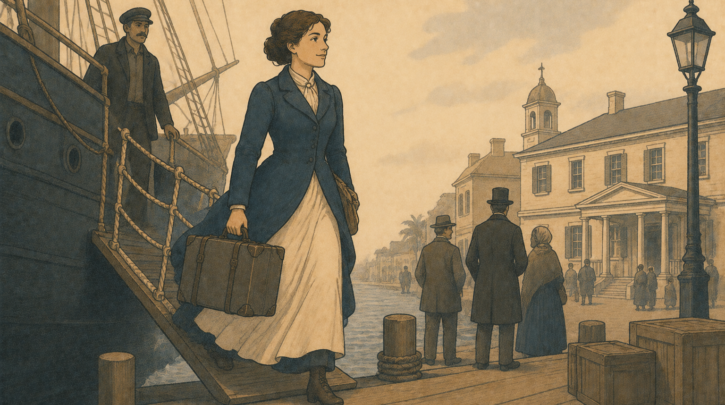

If you have French-Canadian ancestry, the odds are very good that one—or more likely several—of the Filles du Roi, the “King’s Daughters,” sit in your family tree. These roughly 770 women, sent to New France under royal sponsorship between 1663 and 1673, are among the most celebrated of all the colony’s founders, and their descendants today number in the millions. Here is who they were, why they came, and how to find yours.
Who were the Filles du Roi?
The Filles du Roi were women recruited and sponsored by the French crown to emigrate to New France and marry the colony’s overwhelmingly male settler population. The name reflects the fact that King Louis XIV acted as their symbolic guardian and benefactor, often providing a dowry or a royal gift to help establish each woman in the colony.
The program ran from 1663 to 1673, the decade when the crown took direct control of the colony and set out to make it self-sustaining. Roughly 770 women came over those years—a small number that produced an outsized legacy, because nearly all married quickly and raised large families.
Not sure where to start with your French-Canadian ancestry?
Get the French-Canadian Genealogy Quick-Start Checklist — a 6-step path to your first real ancestor record, plus the surname quirk that trips up almost every beginner.
Why the crown sent them
By the 1660s, New France had a serious demographic problem: men vastly outnumbered women, which made stable family formation—and therefore population growth—nearly impossible. The intendant Jean Talon and the royal administration saw that the colony would never thrive without families. Sponsoring the emigration of marriageable women was the solution, paired with incentives for early marriage and large families. It worked: within a generation the colony’s population was growing rapidly from within.
Correcting the myth
A persistent and unfair myth paints the Filles du Roi as women of low repute. The historical record says otherwise. The great majority were poor but respectable—orphans, daughters of modest families, and young women from charitable institutions, a significant share recruited through the Hôpital général in Paris (the Salpêtrière). They came seeking opportunity and a future that France’s crowded marriage market did not offer them. To descend from a Fille du Roi is to descend from a woman who crossed an ocean alone to build a life—something closer to courage than scandal.
How to find out if you descend from one
Because the Filles du Roi are so thoroughly studied, confirming descent is often straightforward once your tree reaches the right era:
- Trace your lines back to the 1660s–1670s using the method in our step-by-step guide—climb through marriages until you reach women marrying in that decade.
- Check a Filles du Roi list. The definitive scholarly work is Yves Landry’s study of the Filles du Roi, which catalogs the women individually; several societies and databases also maintain searchable lists.
- Confirm with PRDH-IGD, which reconstructs these founding families and links each woman to her marriage and children.
- Read the original records to verify the marriage and parentage rather than relying on a list alone.
Identifying your immigrant ancestor is a records job: work back through marriages on Généalogie Québec and PRDH-IGD until you reach the one born in France, then use the free Fichier Origine via BAnQ to pin down the French parish.
Tracing a Fille du Roi back to France
Many Filles du Roi can be traced to a specific French parish of origin, because their recruitment and marriage were documented. The free Fichier Origine database and Landry’s research often supply the French town, frequently in the Paris region, Normandy, or western France. From there, continuing into French records follows the path in tracing your ancestry back to France—with the usual caveat that surviving French parish registers vary by region.
A shared inheritance
Because the founding population was small and these women married into it so completely, descent from the Filles du Roi is astonishingly widespread—most people with deep French-Canadian roots carry many of them. Identifying yours connects your family to the deliberate, royal-scale project that turned a struggling outpost into a permanent society. For the soldiers who arrived in the same era and often married these very women, see our guide to the Carignan-Salières Regiment.
Recommended reading (available on Amazon):
- Les Filles du roi au XVIIe siècle (Yves Landry)
- Dictionnaire généalogique des familles du Québec (René Jétté)
Frequently asked questions
How many Filles du Roi were there?
About 770 came to New France between 1663 and 1673. Despite the small number, their descendants today number in the millions because nearly all married and raised large families.
Were they really sent by the king?
The crown sponsored and funded the program, and Louis XIV often provided a dowry or gift—hence “King’s Daughters.” They were not literally royal; the name reflects royal patronage.
How do I prove descent for a lineage society?
You need a documented chain of original records from yourself back to the Fille du Roi. Build it with Généalogie Québec and verify each generation against the registers.
The marriage market they entered
A Fille du Roi arriving in the colony entered an environment unlike anything in France: marriageable men far outnumbered women, so a newcomer often married within weeks or months of arrival. Marriage contracts were drawn up before a notary, and a woman could—and sometimes did—break an engagement and choose another suitor. For poor women with few prospects in France, this was a genuine, if daunting, expansion of choice, which is part of why the program attracted volunteers at all.
Joining a lineage society
Descent from a Fille du Roi is the basis for membership in lineage societies dedicated to these founders (often paired with the Carignan-Salières soldiers). To join, you submit a documented chain of original records from yourself back to the ancestress. The exercise is worthwhile even if you never join: it forces you to verify every generation against the registers rather than trusting an online tree, which is exactly the discipline that makes a tree reliable.
How widespread is descent?
Because the founding population was small and the Filles du Roi married into it so completely, demographers estimate that the overwhelming majority of people with deep French-Canadian roots descend from these women—usually from many of them, on many different lines. If you have Québécois ancestry going back to the seventeenth century, the question is rarely whether you descend from a Fille du Roi but how many and through which lines.
What records to expect
A Fille du Roi typically leaves a clear documentary footprint: a marriage contract drawn up before a notary, the parish marriage record itself, the baptisms of her children, and eventually her burial. Many also appear in the recruitment and emigration documentation studied by historians, which is how their French origins were established. Assemble these and you have not just a name on a list but a documented life—arrival, marriage, family, and death—anchoring your descent.
The bottom line: if your roots reach seventeenth-century Québec, you almost certainly descend from one or more Filles du Roi. Trace your lines to the 1660s–1670s, check them against Landry’s catalog and PRDH, and verify each link in the original records—and you will likely meet several of these remarkable founding mothers.