
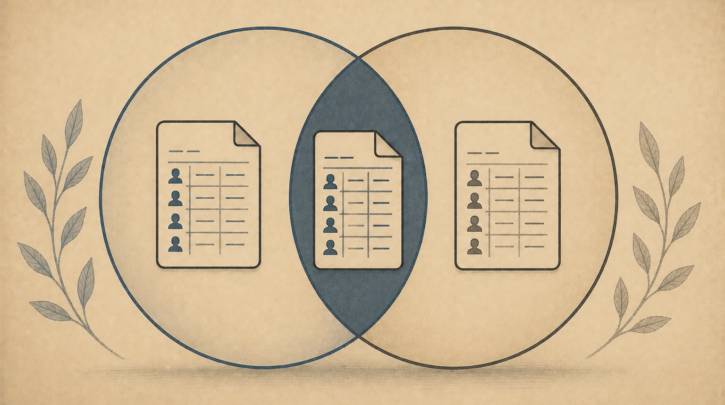

Two indexes dominate day-to-day French-Canadian searching: LAFRANCE, on the subscription site Généalogie Québec, and BMS2000, a collaborative project of Québec genealogical societies. They overlap, they disagree, and using them together is one of the most reliable habits in the field. This guide explains what each is and how to combine them.
Généalogie Québec (and LAFRANCE)
Généalogie Québec is the flagship platform of the Institut Généalogique Drouin. One subscription bundles several tools, but two matter most:
- The Drouin Collection—15 million-plus original register images covering Québec, Acadia, and French New England.
- LAFRANCE—a high-quality index of baptisms, marriages, and burials that links directly to the matching Drouin image, so you go from search result to original document in a click.
LAFRANCE is particularly strong because it is carefully indexed and image-linked. When it covers your record, it is often the fastest route from a name to a photograph of the original.
Not sure where to start with your French-Canadian ancestry?
Get the French-Canadian Genealogy Quick-Start Checklist — a 6-step path to your first real ancestor record, plus the surname quirk that trips up almost every beginner.
BMS2000
BMS2000 is a different animal: a collaborative index built by a federation of Québec and Franco-American genealogical societies. “BMS” is baptêmes, mariages, sépultures—baptisms, marriages, burials. It pools the indexing work of dozens of societies into one searchable database of many millions of records.
Because it draws on so many contributors, BMS2000 sometimes includes parishes, time periods, or individual records that LAFRANCE has not yet indexed—and vice versa. It is an index rather than an image archive, so you typically use it to locate a record and then go to the Drouin images or BAnQ to view the original.
How they compare
- Coverage: Both are broad; neither is complete. Their gaps don’t overlap perfectly, which is exactly why you check both.
- Images: Généalogie Québec links to original images; BMS2000 is index-only.
- Access: Both are subscription services. Généalogie Québec bundles the Drouin images, which is why it is usually the primary subscription for serious research.
- Reconstructions: Neither reconstructs families the way PRDH-IGD does—for that, PRDH remains the specialist tool for 1621–1849.
Ready to pull the actual records? The Drouin Collection and the LAFRANCE index live behind one subscription at Généalogie Québec — the fastest path into Québec baptisms, marriages, and burials. The same Drouin images are also searchable on Ancestry, and MyHeritage is strong for matching across modern trees. See our full records subscriptions guide for which one fits your search.
The professional workflow: use both
Experienced researchers treat the two indexes as cross-checks. The pattern looks like this:
- Search LAFRANCE on Généalogie Québec and open the linked Drouin image when you get a hit.
- If LAFRANCE comes up empty or ambiguous, run the same search in BMS2000—it may have indexed the record from a different society’s transcription.
- When the two disagree on a date or a name, go to the original register and let the document settle it.
- For the earliest generations, confirm against PRDH-IGD’s reconstruction.
That triangulation—two indexes plus the original image, with PRDH for the early years—resolves the large majority of conflicts you will encounter.
Which should you pay for first?
If you are choosing one subscription to start, Généalogie Québec is usually the better first purchase because it includes both an index (LAFRANCE) and the original images (Drouin) in one place. Add PRDH when your research reaches the seventeenth and early eighteenth centuries, and lean on free BMS2000 society access or a short subscription when you need a second opinion. For how this fits the broader process, see the step-by-step ancestry guide.
Recommended reading. A few standards worth keeping on the desk (all available on Amazon):
- A Genealogist’s Handbook for French-Canadian Research
- French-Canadian Sources: A Guide for Genealogists
What else is on Généalogie Québec
LAFRANCE and the Drouin images are the headline tools, but a subscription bundles more that is easy to overlook:
- Memorial and death cards (cartes mortuaires), which often give precise death dates and family details for the modern era.
- Obituary collections, valuable for twentieth-century deaths and for naming surviving relatives.
- Supplementary indexes and finding aids that help bridge the gap between the indexed core and the original registers.
Together these extend your reach past the formal BMS registers into the recent past, where parish-register access is limited by privacy rules.
Cost and access
Both Généalogie Québec and BMS2000 are subscription services, typically sold by the month or year, and many BMS2000 records are also reachable through member genealogical societies. Because pricing and bundles change, confirm current terms before subscribing—and consider timing a paid month around a focused research push so you extract maximum value from it.
Frequently asked questions
Can I rely on just one of these?
For casual research, Généalogie Québec alone (index plus images) covers most needs. Serious researchers check BMS2000 too, because the two indexes have different gaps and the cross-check catches records and errors a single source would miss.
Where does PRDH fit?
PRDH-IGD is a separate service with its own subscription. It does something neither LAFRANCE nor BMS2000 does—full family reconstruction for 1621–1849—so it complements rather than replaces them.
Search tips that work on both indexes
- Search the marriage first. It names both spouses’ parents, so a single hit advances two lines at once.
- Loosen before you tighten. Start with surnames and a wide date range, then narrow—early dates are approximate and over-precise searches miss real records.
- Try every spelling. Phonetic spelling means Gauthier/Gautier/Gaultier and similar variants may each hide your family.
- Search the dit name too. A family indexed under “Beauchemin” in one record may be “Lavigne” in the next.
- When one index is blank, run the other. LAFRANCE and BMS2000 were built from different transcriptions, so their gaps rarely coincide.
At a glance
Think of it this way: Généalogie Québec (LAFRANCE) is your primary tool because it links each indexed record to the original Drouin image; BMS2000 is your indispensable second opinion, with different coverage and no images; and PRDH-IGD is the specialist that reconstructs whole families for 1621–1849. Most experienced researchers keep access to all three and let them check one another.
From an index hit to the document chain
Finding a name in LAFRANCE or BMS2000 is the start, not the finish. The disciplined next step is to open the linked or corresponding original record, confirm the parents and dates with your own eyes, and capture the image. This matters doubly if your tree is feeding a citizenship-by-descent case, where what counts is an unbroken chain of original vital records, not index entries. The good news is that the same subscription that indexes the record also shows you the document, so building a defensible chain and building your family tree are the same set of clicks. Index to locate, image to confirm, citation to record—run that loop on every entry and your research stays solid no matter how far back it reaches.