
Not every French-Canadian heritage trip leads to Québec. For the millions of Americans descended from the great migration south—the hundreds of thousands of French-Canadians who left Québec between roughly 1840 and 1930 for the mills of New England—the ancestral places are much closer to home. They are the brick mill towns of Massachusetts, New Hampshire, Rhode Island and Maine, and the Petits Canadas, the Little Canadas, that Franco-Americans built within them. This is a guide to visiting that world.
Understanding the Petits Canadas
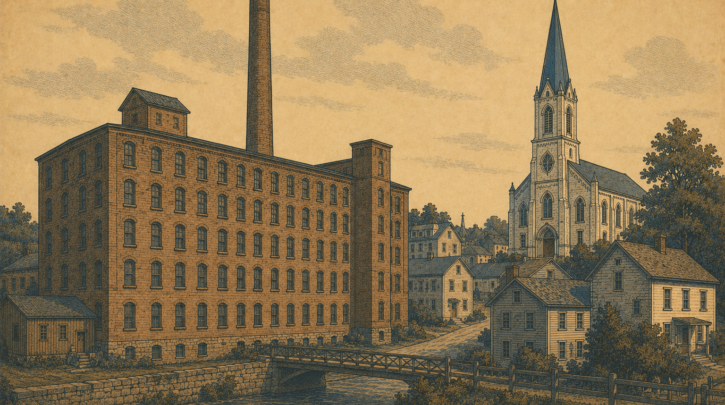
When French-Canadian families poured into the textile and shoe towns of New England, they did not assimilate quietly. They recreated Québec in miniature: a national parish with a French-speaking priest, a parochial school run by French-Canadian nuns, French-language newspapers, mutual-aid societies and shops, all clustered around the church. These Petits Canadas were dense, self-contained Franco worlds, and their physical remnants—the towering Catholic churches especially—still mark the townscapes today.
Understanding this is the key to a Franco-American heritage trip: you are not looking for a single farmhouse but for the neighbourhood, the parish and the mill that organised your family’s American life. Our guide to the Franco-American migration explains how and why they came; this one tells you where to go and see it.
To visit the right town you first need to trace the family across the border. The same Drouin records that document Québec also hold the border-crossing and parish records that follow your family south—see access on our records hub.
Not sure where to start with your French-Canadian ancestry?
Get the French-Canadian Genealogy Quick-Start Checklist — a 6-step path to your first real ancestor record, plus the surname quirk that trips up almost every beginner.
The essential mill towns
Several New England cities were major centres of French-Canadian settlement and remain the best places to encounter Franco-American heritage:
- Woonsocket, Rhode Island — home to the outstanding Museum of Work and Culture, which tells the Franco-American mill story better than any other institution, and to the American-French Genealogical Society, a treasure for researchers.
- Lowell, Massachusetts — the great cradle of the American Industrial Revolution, with Lowell National Historical Park preserving the mills and canals where so many French-Canadians worked.
- Manchester, New Hampshire — once dominated by the vast Amoskeag Manufacturing Company, with a large and enduring Franco-American community and the historic Sainte-Marie parish.
- Lewiston, Maine — one of the most thoroughly French-Canadian cities in the United States, its mills and parishes still bearing the mark of the families who filled them.
- Fall River and New Bedford, Massachusetts; Biddeford, Maine — further mill centres with deep Franco roots and surviving national churches.
What to look for
In each town, a few kinds of place repay a visit and connect you directly to your family’s life there:
- The national parish church — the heart of the Petit Canada. Even where parishes have closed or merged, these monumental churches survive, and their records hold your family’s American baptisms and marriages.
- The mills — many are now museums, apartments or arts spaces, but standing before them you grasp the scale of the work that drew your ancestors and shaped their days.
- Local historical societies and Franco-American museums — the Museum of Work and Culture above all, but many towns have collections that bring the Petit Canada to life.
- The cemeteries — Franco-American Catholic cemeteries where the Québec surnames, sometimes anglicized, are gathered in stone.
Connecting the American and Québec stories
A Franco-American heritage trip is most powerful when joined to its Québec roots. Your family’s story did not begin in Lowell or Woonsocket; it arrived there from a specific parish in Québec, and the records let you trace the join. Find the border-crossing or the American parish marriage that names the Québec town of origin, and you can extend your New England pilgrimage with a trip north to the ancestral parish itself—the full arc of the family’s journey, walked in reverse.
A living heritage
Franco-American identity did not vanish with the mills. Cultural organisations, festivals, French-language Masses and genealogical societies keep it alive across New England, and a heritage traveller can still find communities that remember. Engaging with them—joining a society like the American-French Genealogical Society, attending a Franco festival, learning the story your great-grandparents lived—is part of reclaiming a heritage that, for many American families, was set aside within living memory and is now being eagerly taken up again.
Trace your family across the border with the Drouin records on our records hub, understand the great migration in our migration guide, and carry the journey home to Québec with the heritage trip guide.
Researching before you visit the mill towns
A Franco-American heritage trip rewards the same preparation as a Québec one, with an extra step: you need to pin down which mill town, and which parish within it, your family belonged to. Families often moved between mill cities chasing work, so a single line might touch Lowell, then Manchester, then a Maine town within two generations. The U.S. census, city directories, and above all the national-parish records—baptisms, marriages, burials in the French Catholic churches—let you place the family precisely in time and street.
The crucial link is the record that names the Québec origin. A border crossing, a marriage entry citing the bride’s home parish, an obituary mentioning the ancestral village—these are the joins between the American and Québec halves of your story, and the Drouin Collection famously includes border and Franco-American parish records as well as Québec ones. Find that join before you travel and your trip gains a destination on both sides of the line.
Genealogical societies as travel partners
New England’s Franco-American genealogical societies are not just research resources; they are gateways to the living community. The American-French Genealogical Society in Woonsocket maintains a major library and is staffed by people who know these families intimately. Visiting in person—to consult records, ask advice, and meet others doing the same work—can turn up exactly the local knowledge that makes a heritage trip sing: which church holds which records, which cemetery your family used, who else is researching your name.
Walking a Petit Canada today
Even where the mills have fallen silent and the parishes thinned, the bones of a Petit Canada are still legible to a visitor who knows what to look for. The neighbourhood pattern survives—the great church set among dense workers’ housing within sight of the mill, the parochial school nearby, the cemetery a little apart. Walking these streets with your family’s addresses from the census in hand, you can often stand before the actual tenement where your great-grandparents raised their children, the church where they were married, the gate they passed through to a twelve-hour shift.
This kind of walking is the heart of a Franco-American heritage trip. It does not require grand monuments; it requires knowing your family’s specific places and bringing them to the streets. A morning spent tracing your ancestors’ daily triangle—home, church, mill—in a town like Lewiston or Woonsocket can be more affecting than any museum, because it is exactly, particularly theirs. And it sets up beautifully the journey back across the border to the Québec parish they left, completing in two countries the single arc of your family’s history. Few heritage journeys are so neatly bracketed: a beginning you can walk in New England and an origin you can walk in Québec, joined by a single record naming the village your people left.