
If PRDH-IGD is the index that tells you a record exists, the Drouin Collection is where you go to read it. It is the single largest body of original French-Canadian church records available online, and almost every serious research project touches it sooner or later. Here is what it contains, where to find it, and how to use it well.
What the Drouin Collection is
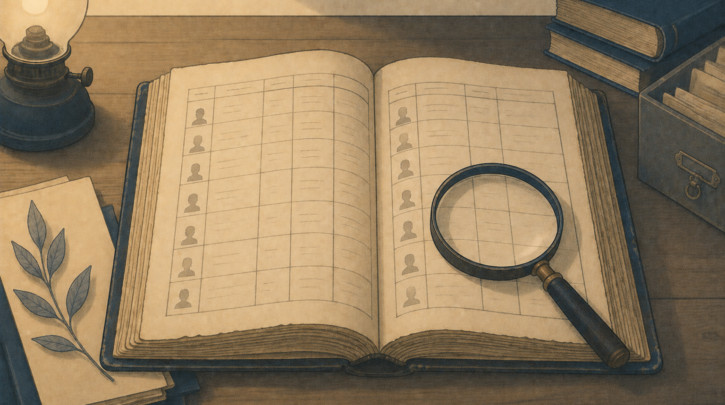
The collection takes its name from the Institut Généalogique Drouin, founded by the genealogist Joseph Drouin and continued by his son. Over decades the institute microfilmed the parish registers of Québec and beyond, preserving the original handwritten baptisms, marriages, and burials. Digitized, that effort became more than 15 million images.
Crucially, the Drouin images are the actual pages the priest wrote—not a transcription. That matters, because an index can mis-read a name or drop a detail, while the original gives you everything: the parents, the witnesses, the godparents, marginal notes, and the priest’s own phrasing.
Not sure where to start with your French-Canadian ancestry?
Get the French-Canadian Genealogy Quick-Start Checklist — a 6-step path to your first real ancestor record, plus the surname quirk that trips up almost every beginner.
What it covers
- Québec parish registers across the colony and province, the core of the collection.
- Acadia and the Maritimes, valuable for Acadian research where records are harder to find.
- French communities in the United States—especially New England—where French-Canadians migrated for mill work, making it essential for Franco-American families.
- Ontario and other French settlements outside Québec.
That geographic reach is what sets Drouin apart. If your family followed the classic path from Québec to a New England mill town, the same collection can often follow them across the border.
Where to access it
There are two main routes, and the right one depends on what else you need.
Généalogie Québec
Généalogie Québec, operated by the Drouin institute, is the home of the collection. A subscription there gives you the Drouin register images plus the LAFRANCE index, which links many records together and lets you jump straight to the right image. For French-Canadian work specifically, this is usually the most efficient single subscription.
Ancestry
Ancestry also hosts the Drouin Collection (sometimes labeled the “Drouin Collection” in its card catalog). If you already subscribe to Ancestry for other branches of your family, you may be able to view many Drouin images there without a separate Généalogie Québec account. Ancestry’s indexing and hint system can also surface records you weren’t searching for.
Ready to pull the actual records? The Drouin Collection and the LAFRANCE index live behind one subscription at Généalogie Québec — the fastest path into Québec baptisms, marriages, and burials. The same Drouin images are also searchable on Ancestry, and MyHeritage is strong for matching across modern trees. See our full records subscriptions guide for which one fits your search.
How to search the images effectively
- Find the record in an index first. Use PRDH, LAFRANCE, or BMS2000 to get a parish and a date, then open the matching Drouin image. Browsing blind through a parish’s registers is slow.
- Know the register structure. Records run chronologically within a parish, usually with baptisms, marriages, and burials interleaved or grouped by year. Note the year headings as you scroll.
- Read around your target. Neighboring entries often involve the same family—siblings baptized, relatives as witnesses—so the page before and after can be as useful as the record itself.
- Download or screenshot the image. Save it with the parish, date, and names in the filename so your evidence is reproducible.
Reading what you find
Drouin images are originals, which means old French handwriting and, for earlier records, Latin. If the script looks impenetrable at first, that is normal—our guide to reading old French-Canadian records covers the standard formulas and abbreviations so you can extract names and dates with confidence.
Drouin in your overall workflow
The efficient pattern is: index to find it, Drouin to read it, notarial records to deepen it. The index points you to the right parish and date; the Drouin image confirms the names and relationships; and a marriage contract or estate inventory adds the texture—and sometimes rescues a line when the church record is missing.
Recommended reading. A few standards worth keeping on the desk (all available on Amazon):
- French-Canadian Sources: A Guide for Genealogists
- A Genealogist’s Handbook for French-Canadian Research
For where the Drouin Collection fits in the larger process, see our complete guide to tracing French-Canadian ancestry.
Why an image beats an index entry
It is tempting to stop at the index and copy down the names. Resist it. The original record routinely contains details no index captures: the godparents and witnesses (often relatives who extend your tree sideways), marginal notes added later, an exact birth date alongside the baptism, and occasionally a statement of where a newcomer came from. The index tells you the record exists; the Drouin image tells you what it says.
Finding hard-to-locate parishes
- Confirm the correct parish name and founding date—a family in a new settlement may have its early records filed under the older “mother” parish nearby.
- For records near a parish boundary, check the neighboring parish; people sometimes used whichever church was closer that week.
- When a parish has gaps, fall back to the duplicate civil copy on BAnQ or to a marriage contract.
Frequently asked questions
Is the Drouin Collection the same on Ancestry and Généalogie Québec?
It is largely the same body of images, but the indexing and search tools differ. Généalogie Québec pairs the images with the image-linked LAFRANCE index; Ancestry integrates them into its hint and tree system. If you already pay for Ancestry, start there; for dedicated French-Canadian work, Généalogie Québec is usually more efficient.
Does the collection cover my Franco-American family in New England?
Often yes. The Drouin Collection includes French-parish records from New England and other U.S. communities where French-Canadians settled, which is what makes it valuable for cross-border research.
Saving and citing what you find
Treat every Drouin image as a piece of evidence you may need to defend or revisit—especially if your research feeds a citizenship application, where the document chain has to be airtight. Download or screenshot the image and name the file with the parish, year, record type, and the principal names, so the evidence is reproducible. Note the collection, parish, and date in your tree as a citation. A year from now you will not remember which of a dozen “Marie Tremblay” records you used; a clean filename and citation mean you never have to find it twice.
What the collection does not cover
Know the edges so you don’t waste time. The Drouin Collection is overwhelmingly Catholic parish material, so non-Catholic records fall outside it. Recent records are limited by privacy rules, so the most modern generations may not appear. And the collection documents the North American end of the story—it will take you to the immigrant ancestor and their colonial records, but to continue into France itself you move to French records and Fichier Origine. Within its lane, though—Catholic Québec, Acadia, and French North America from the seventeenth century onward—it is the deepest image archive available.