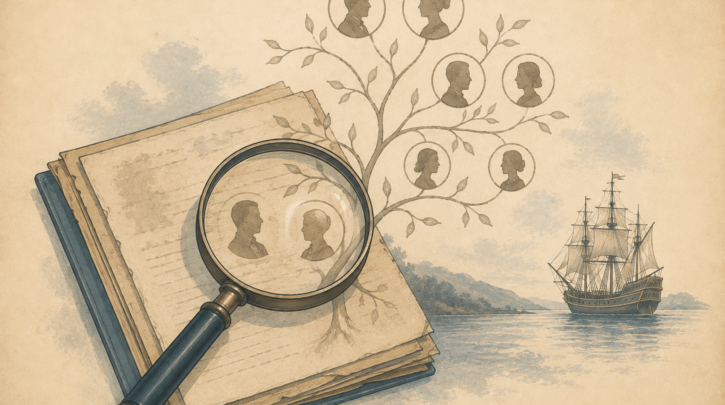

If your family carries a name like Tremblay, Gagnon, Roy, Côté, or Bouchard—or an anglicized version such as Drake, Bushey, or King—there is a very good chance you descend from the roughly 10,000 French settlers who founded New France in the seventeenth century. French-Canadian genealogy is, in fact, one of the most rewarding branches of family history in the world: the Catholic Church recorded nearly every baptism, marriage, and burial from 1621 onward, and those registers survive almost intact. With patience and the right sources, most people of French-Canadian descent can trace a line all the way back to a specific ancestor who stepped off a ship from France.
This guide lays out the whole process from start to finish. Work through it in order. Each step links to a deeper article when you are ready to go further.
Step 1: Start with yourself and work backward
The single most common mistake in genealogy is jumping straight to a famous-sounding ancestor and trying to connect downward. Don’t. Genealogy is built one generation at a time, from the known to the unknown. Begin with what you can document about yourself, then your parents, then your grandparents.
Gather names, dates, and places for births, marriages, and deaths. Talk to your oldest living relatives first—memories and family papers disappear fast. Look for baptismal certificates, marriage records, obituaries, funeral cards (a French-Canadian tradition packed with dates), old letters, and the backs of photographs.
- Write down full names, including middle names and maiden names.
- Record the parish as well as the town—in Québec, the parish is the unit that matters.
- Note approximate dates even when you don’t have exact ones; a decade is enough to start.
Not sure where to start with your French-Canadian ancestry?
Get the French-Canadian Genealogy Quick-Start Checklist — a 6-step path to your first real ancestor record, plus the surname quirk that trips up almost every beginner.
Step 2: Understand why French-Canadian research is unusually easy
Most genealogists hit walls within a few generations. French-Canadian researchers often don’t, and the reason is the records. From the founding of the colony, Catholic priests kept a register of every baptême (baptism), mariage (marriage), and sépulture (burial)—the so-called BMS records. A second copy was sent to the civil authorities each year, so even where one copy burned, the other usually survives.
On top of that, generations of scholars have indexed and reconstructed these records into searchable databases. You are not starting from a blank page; you are stepping into one of the best-documented populations on earth. Our overview of Québec parish records explains what these registers contain and how to read them.
Step 3: Get onto the major databases
Four resources do most of the heavy lifting in French-Canadian genealogy. You do not need all four at once, but you should know what each one is for.
PRDH-IGD
The PRDH-IGD (Programme de recherche en démographie historique, Université de Montréal) is the gold standard. It indexes every Catholic record in Québec from 1621 to 1849 and—crucially—reconstructs them into family files, so you can see a couple, their marriage, and all their children linked together. For early generations, PRDH is unmatched.
Généalogie Québec and the Drouin Collection
Généalogie Québec hosts the Drouin Collection—more than 15 million scanned register images covering Québec, Acadia, and French communities in the United States—plus the LAFRANCE index. This is where you read the original handwriting, not just an index entry.
BMS2000
BMS2000 is a collaborative index built by a consortium of Québec genealogical societies. It often catches records or date ranges the other indexes miss, which makes it a valuable second opinion.
BAnQ
Bibliothèque et Archives nationales du Québec—BAnQ—is free and holds digitized parish registers, the enormous notarial archives, land records, and more. Always check what BAnQ offers before paying for it elsewhere.
Ready to pull the actual records? The Drouin Collection and the LAFRANCE index live behind one subscription at Généalogie Québec — the fastest path into Québec baptisms, marriages, and burials. The same Drouin images are also searchable on Ancestry, and MyHeritage is strong for matching across modern trees. See our full records subscriptions guide for which one fits your search.
Step 4: Trace the line back to the first immigrant
Working backward through marriages is the engine of French-Canadian research, because a Catholic marriage record names the bride and groom’s parents. Each marriage hands you the previous generation. Repeat the process and you climb the tree marriage by marriage until you reach an ancestor who was born in France rather than in the colony—your first immigrant ancestor.
Many of these founders belong to well-documented groups: the Filles du Roi (the “King’s Daughters” sent to marry settlers between 1663 and 1673), the soldiers of the Carignan-Salières Regiment, and the early habitants. Once you identify your immigrant, the Fichier Origine database can often tell you the exact parish in France they came from—usually in Normandy, Perche, Poitou, Aunis, or the Île-de-France.
Step 5: Learn to read the originals
Indexes are a starting point, not the destination. The original records are written in old French—and the older ones in Latin—in handwriting that takes practice to decode. Our guide to reading old French-Canadian records walks through the standard formulas, abbreviations, and dating conventions so the registers stop looking like a wall of cursive and start telling you a story.
Step 6: Use notarial records to add depth
Québec’s notarial records are a genealogist’s secret weapon. Marriage contracts, wills, estate inventories, and land deeds survive in staggering numbers and often name relatives, describe property, and confirm relationships that the church registers only hint at. A marriage contract drawn up a few days before the wedding can rescue a line when the parish record is missing or illegible.
Step 7: Confirm with DNA where it helps
DNA testing is a useful companion to paper research, especially for confirming connections and finding living cousins. Be aware that French-Canadians descend from a relatively small founding population, which produces endogamy—everyone is related to everyone many times over—so match lists need careful interpretation. Our DNA guide covers which test to choose and how to read French-Canadian results.
When you hit a wall
Even with these records, you will eventually get stuck—a missing register, a common name, an ancestor who appears from nowhere. That is normal. Our guide to French-Canadian brick walls collects the techniques that break the most common ones. And if your roots run to the Maritimes rather than the St. Lawrence, start instead with Acadian genealogy, which follows a different and often harder path.
A note for citizenship seekers
If you are researching because you may qualify for Canadian citizenship by descent, the genealogical chain and the legal chain are the same documents: an unbroken series of Québec vital records linking you to a Canadian-born ancestor. Building your tree properly is the first step toward an application, which is one more reason to work carefully from the start.
Recommended reading. A few standards worth keeping on the desk (all available on Amazon):
- French-Canadian Sources: A Guide for Genealogists (Geyh, Marchand, et al.)
- A Genealogist’s Handbook for French-Canadian Research (American-Canadian Genealogical Society)
- Finding Your French-Canadian Ancestors
Start with Step 1 today—one generation, documented properly—and within a few evenings you will likely be reading a baptism written by a priest more than three centuries ago.
How far back can you realistically go?
For most people of French-Canadian descent, the honest answer is “all the way to the founding immigrant”—typically an ancestor who arrived in the seventeenth or early eighteenth century. Because the parish registers begin in 1621 and survive almost unbroken, the colonial portion of the tree is the easiest part to document, not the hardest. The wall usually comes not in Canada but in France, where many parish registers from that era did not survive. Reaching your immigrant ancestor and identifying their French parish is a realistic goal for the large majority of researchers.
Frequently asked questions
Do I need to read French to do this research?
It helps, but you can get a long way without fluency. The records follow fixed formulas, and the major indexes return names and dates you can act on. Our guide to reading old records gives you the small vocabulary that unlocks most documents.
How much does it cost to get started?
You can begin for free using BAnQ and family papers. A single subscription to Généalogie Québec is usually the highest-value first purchase, with PRDH-IGD added when you reach the earliest generations.
My surname was anglicized—can I still trace it?
Yes. Anglicized and translated names are extremely common; see our work on surname origins, dit names, and anglicization to recover the original.