
Not every French-speaking ancestor in North America came from Québec. The Acadians settled the Maritimes—today’s Nova Scotia, New Brunswick, and Prince Edward Island—beginning in the early 1600s, and they developed a distinct society with its own families, records, and tragic history. If your roots run to Acadia, your research follows a different and often harder path than St. Lawrence genealogy. Here is how to approach it.
Acadia is not Québec
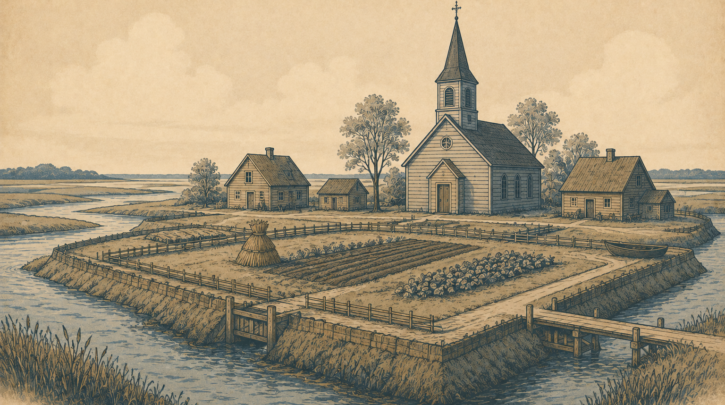
Acadians and Québécois share a French origin but formed separate populations. Acadia was founded around 1604 and grew as a compact community of intermarried families along the Bay of Fundy. Its records, its surnames, and above all its history diverge sharply from Québec’s—so the databases and strategies that make Québec research easy only partly apply.
Not sure where to start with your French-Canadian ancestry?
Get the French-Canadian Genealogy Quick-Start Checklist — a 6-step path to your first real ancestor record, plus the surname quirk that trips up almost every beginner.
The shadow over all Acadian research: the deportation
The defining event of Acadian history is the Grand Dérangement, the deportation of 1755 and the years following, when British authorities expelled the Acadians from their homeland. Families were scattered to the American colonies, to England and France, and eventually many made their way to Louisiana, where they became the Cajuns. Others returned north over the following decades.
For genealogists, the deportation is a records catastrophe. Parish registers were lost or destroyed, families were separated and renamed, and the neat continuity that makes Québec research straightforward is broken. Tracing a line through 1755 is the central challenge of Acadian genealogy, and it is why the field relies so heavily on reconstructed sources.
Key sources for Acadian research
- Surviving parish registers, including those in the Drouin Collection, which covers Acadia as well as Québec.
- Reconstructed genealogies. Because original records are fragmentary, scholars have painstakingly reconstructed Acadian families. Bona Arsenault’s Histoire et généalogie des Acadiens is a landmark, and Stephen White’s Dictionnaire généalogique des familles acadiennes (covering the founding period to 1714) is the scholarly standard.
- Deportation and resettlement records, including ship lists, censuses taken in exile, and records from France and Louisiana.
- Early censuses of Acadia, which are unusually important here because they capture families the lost registers cannot.
Many Acadian records sit inside the same Drouin Collection you would use for Québec, available through Généalogie Québec and Ancestry—so a single subscription often covers both sides of a mixed Québec-Acadian tree.
Acadian surnames
Acadia produced a recognizable set of founding surnames—names like Leblanc, Thériault (Terriot), Hebert, Landry, Bourgeois, Comeau, Melanson, and Doucet recur throughout the population. Because the community was small and intermarried, these names cluster densely, which both helps (a name signals likely Acadian origin) and complicates (many unrelated-seeming people share ancestors). Our guide to French-Canadian and Acadian surnames goes deeper.
Endogamy and DNA
The small founding population and centuries of intermarriage make Acadians intensely endogamous—even more so than Québécois in many lines. DNA testing can help confirm Acadian ancestry and find relatives, but match lists are dominated by distant cousins who connect on many lines at once, so read them with care. See our DNA guide for how to interpret endogamous results.
Following the diaspora
Acadian descendants today live across the Maritimes, in Québec, throughout New England, and most famously in Louisiana. Tracing a family often means following it across all of these: a line might run from the Bay of Fundy to exile in Massachusetts to a Louisiana bayou, or back to a returning settlement in New Brunswick’s Acadian coast. Knowing the migration history tells you which records to search and where.
A research strategy
- Start, as always, with yourself and work backward using whatever records survive.
- Lean on the reconstructed dictionaries (White, Arsenault) to bridge the deportation gap.
- Use censuses and exile records to follow scattered families.
- Check the Drouin images for surviving Maritime registers.
- Expect brick walls at 1755—and plan to climb around them with reconstructed sources rather than through a clean register chain.
Recommended reading. A few standards worth keeping on the desk (all available on Amazon):
- Dictionnaire généalogique des familles acadiennes (Stephen A. White)
- Histoire et généalogie des Acadiens (Bona Arsenault)
- Acadian-Cajun Genealogy: Step by Step
Acadian genealogy asks more of you than Québec research, but the reconstructed scholarship is so strong that even the deportation rarely stops a determined researcher. For the broader French-North-American picture, return to our guide to tracing French-Canadian ancestry.
Acadian census records
Because so many Acadian parish registers were lost, the colony’s early censuses carry unusual weight. Several nominal censuses taken before the deportation list households by name, often with ages and family relationships, effectively standing in for the missing vital records. For pre-1755 Acadian families, a census entry is frequently the anchor that the reconstructed dictionaries are built around, and it can be the difference between a documented ancestor and a guess.
Exile, return, and resettlement
After 1755 Acadian families dispersed widely—to the British colonies, to France, and ultimately many to Louisiana, where they became the Cajuns. Others trickled back north in the decades that followed, founding new communities along the Acadian coast of New Brunswick and elsewhere in the Maritimes. Tracing a family through this period means reading exile-era records, resettlement registers, and the censuses taken wherever they landed.
Frequently asked questions
How do I know if my ancestry is Acadian rather than Québécois?
Surname is the first clue—names like Leblanc, Landry, Thériault, Hebert, and Doucet are strongly Acadian—followed by geography (the Maritimes, parts of New England, and Louisiana). The reconstructed Acadian dictionaries confirm it.
Can DNA confirm Acadian roots?
It can, but Acadian populations are heavily endogamous, so matches connect on many lines at once and must be read carefully. See our DNA guide.
Where Acadians settled—and where the records live
Pre-deportation Acadia clustered in a handful of settlements whose names recur throughout the records: Port-Royal (the oldest), Grand-Pré, Beaubassin, Pisiguit, and Cobequid among them. Knowing which settlement a family belonged to helps you target surviving registers and censuses. For deeper research, the major scholarly home of Acadian genealogy is the Centre d’études acadiennes at the Université de Moncton, which underpins Stephen White’s dictionary and holds extensive collections. Combine those reconstructed and institutional sources with the surviving Maritime registers in the Drouin Collection, and you have the standard Acadian toolkit—reconstruction first, original records where they survive.
Records of the return
Acadian research doesn’t end at the deportation—it picks up again with the communities that reformed afterward. From the late eighteenth century onward, returning and resettling Acadians founded new parishes across New Brunswick’s Acadian coast, parts of Nova Scotia and Prince Edward Island, the Îles-de-la-Madeleine, and beyond, and those parishes kept registers like any other. For a family that survived the exile and came back, the post-1764 parish records of these resettlement communities are your continuous source again, bridging from the reconstructed deportation-era scholarship into the ordinary BMS register research you would do anywhere. Trace forward from a known resettlement parish and backward through the reconstructed dictionaries, and the two meet across the gap of 1755.