
If you grew up in a New England family with a French surname, attending a French Catholic parish, with grandparents who spoke French at home, you are almost certainly descended from one of the great migrations of North American history: the movement of roughly 900,000 French-Canadians from Québec into the mill towns of New England between the 1840s and the 1930s. For the millions of Franco-Americans in the United States today, this migration is the bridge between an American present and a Québécois past—and understanding it is the key to tracing your roots across the border.
Why they came
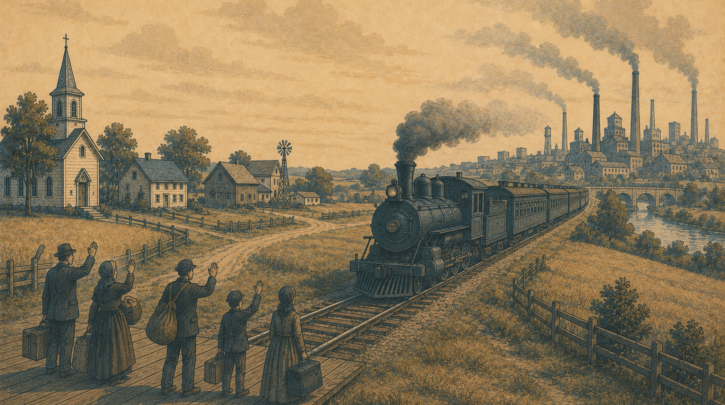
The migration was driven by a simple equation. In nineteenth-century Québec, large families and limited farmland created mounting pressure—there was not enough land to provide for every son. At the same time, the textile mills of New England were booming and desperate for labor. The railroads made the journey south easy. Whole families left Québec farms for wages in the mills of Massachusetts, Rhode Island, New Hampshire, Maine, and Connecticut. What began as seasonal and temporary often became permanent.
Not sure where to start with your French-Canadian ancestry?
Get the French-Canadian Genealogy Quick-Start Checklist — a 6-step path to your first real ancestor record, plus the surname quirk that trips up almost every beginner.
The Little Canadas
French-Canadian migrants clustered together in mill-town neighborhoods that came to be called Petits Canadas—Little Canadas. In cities like Lowell, Fall River, and Lawrence in Massachusetts; Woonsocket, Rhode Island; Manchester, New Hampshire; and Lewiston and Biddeford, Maine, they built a full community life: French-language Catholic national parishes, French schools, mutual-aid societies, and French newspapers. These neighborhoods preserved language and faith in a way that left a deep documentary trail—parish records, society memberships, and the institutions of an immigrant community determined to endure.
La Survivance
That determination had a name: la survivance—survival. It was the guiding ideal that Franco-Americans should preserve their French language, Catholic faith, and culture even while living in the United States. La survivance is why so many Franco-American families kept French alive for generations, and why the parish—the national parish in particular—sits at the center of so much Franco-American genealogy.
Tracing a Franco-American family back to Québec
Here is the good news for researchers: because the migration was relatively recent and both sides kept good records, the trail across the border is usually traceable. The work runs in two halves:
- The U.S. side. Use federal and state censuses, which capture the family in the mill town and often note birthplaces and immigration years; vital records; and especially the records of the French national parish, which recorded baptisms, marriages, and burials in the community.
- The crossing and the Québec side. Border-crossing records and the parish registers connect the U.S. family back to its parish of origin in Québec—after which you pick up standard French-Canadian research and climb toward the founding immigrant.
A key advantage for Franco-American research: the Drouin Collection includes the records of many French parishes in New England, not just Québec—so a single Généalogie Québec or Ancestry subscription can often follow your family on both sides of the border, from a Woonsocket baptism back to a Québec marriage.
Reconnecting with your roots
For many Franco-Americans, researching this migration is the first step in a larger reconnection—with a language a grandparent spoke, a Québec parish a family came from, even a possible claim to Canadian citizenship through that Canadian-born ancestor. Wherever it leads, it begins here, with the mill towns and the Little Canadas. To explore the heritage side of that journey, see our guide to Franco-American heritage in New England; for the broader idea of reclaiming this inheritance, read reclaiming your French-Canadian heritage.
Recommended reading (available on Amazon):
- French-Canadian Sources: A Guide for Genealogists
- A Genealogist’s Handbook for French-Canadian Research
Frequently asked questions
How many French-Canadians moved to New England?
Roughly 900,000 emigrated from Québec to the United States—mostly to New England’s mill towns—between about 1840 and 1930.
Where should I start if my family is Franco-American?
Start with U.S. censuses and the records of your family’s French national parish to fix them in the mill town, then use border-crossing and parish records to connect back to their Québec parish of origin.
Could I qualify for Canadian citizenship through this line?
Possibly, if you have a Canadian-born ancestor in the right position under current rules. It’s a separate legal question—see our citizenship guide.
The scale and timeline
The movement built slowly in the early nineteenth century, surged after the 1860s as New England industrialized, and continued until the Depression of the 1930s curtailed it. Across that long span, on the order of 900,000 French-Canadians left Québec for the United States—so many that contemporaries worried Québec was being drained of its people. Most went to New England, drawn by the mills, though some settled in New York and the upper Midwest. The sheer number is why Franco-American ancestry is so common across the northeastern United States today.
The mill cities and their Little Canadas
Certain cities became Franco-American capitals. In Massachusetts, Lowell, Fall River, Lawrence, and Holyoke drew tens of thousands; Woonsocket, Rhode Island, became one of the most French cities in the country; Manchester, New Hampshire, grew around its giant textile complex; and Lewiston and Biddeford anchored Franco-American Maine. Each developed a Petit Canada with its own French national parish, parochial schools, French-language press, and mutual-aid societies—institutions that generated exactly the kinds of records genealogists prize.
U.S. records for Franco-American research
- Federal and state censuses place the family in the mill town by year and often record birthplace and year of immigration.
- French national parish records—the baptisms, marriages, and burials of the community’s own church—are frequently the richest source, kept in French and naming relatives.
- Naturalization and vital records document the family’s legal life in the United States.
- Border-crossing records. Systematic records of arrivals from Canada (the St. Albans series and related crossing lists) capture many families entering the U.S. and often note the Québec town they came from—a direct bridge back across the border.
With the U.S. side documented, the Drouin Collection’s coverage of New England French parishes and Québec registers lets you continue seamlessly into standard French-Canadian research.
Repatriation, return, and staying
The exodus alarmed Québec’s leaders, and the Church and government mounted repatriation and colonization campaigns to lure emigrants home or redirect them to newly opened farming regions within Québec. Some families did return, and others moved back and forth across the border for years before settling on one side. Most, in the end, stayed in the United States—which is why their descendants are Americans today. For researchers, this churn means you should expect to find some families crossing the border more than once, leaving records on both sides that you can use to triangulate origins and dates.
The bottom line: if your family is Franco-American, the mill towns are your starting point, not your endpoint. Fix the family in its Petit Canada with censuses and national-parish records, follow the border-crossing and parish records back to a Québec town, and from there the whole apparatus of French-Canadian research opens up—back through the registers to a founding immigrant.