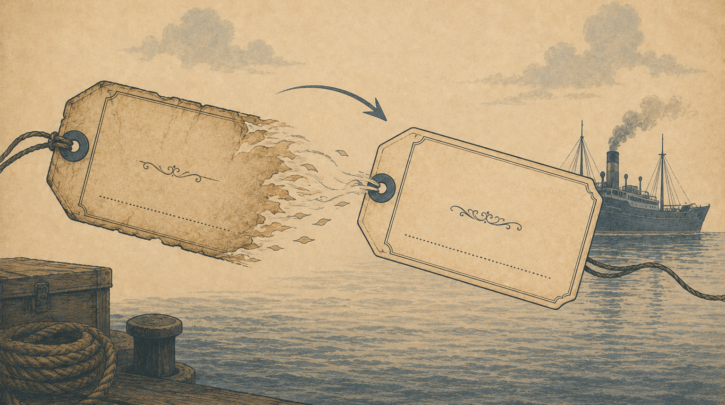

Plenty of people with names like Baker, White, King, or Greenwood have no idea their surname was French within living memory. When French-Canadian families moved into the United States and English-speaking Canada, their names changed—sometimes translated outright, sometimes hammered into a new spelling by an English ear—so that a French name could vanish behind an English-looking one in a single generation. If your family is Franco-American and your name doesn’t look French, this article is for you.
Why French-Canadian names were anglicized
The pressure to change names came from several directions at once. English-speaking clerks, employers, and census takers spelled French names as they heard them, with no concern for French spelling. Schools and workplaces nudged immigrants toward names that were easier for English speakers. And some families anglicized deliberately, to fit in or to ease daily life. The result was a wave of name changes that swept through Franco-American communities, even as those same communities fought to preserve their language and faith under the banner of la survivance.
Not sure where to start with your French-Canadian ancestry?
Get the French-Canadian Genealogy Quick-Start Checklist — a 6-step path to your first real ancestor record, plus the surname quirk that trips up almost every beginner.
The two ways a name changed
Translation
Some names were simply translated into their English meaning. Because so many French surnames are occupational or descriptive, they had ready English equivalents:
- Boulanger (baker) → Baker
- Leblanc (the white) → White
- Roy (king) → King
- Lévesque (the bishop) → Bishop
- Boisvert (greenwood) → Greenwood
- Charpentier (carpenter) → Carpenter
Phonetic respelling
More often, names were respelled to match how they sounded to English speakers, with accents dropped and syllables reshaped. The original is usually recognizable once you say the English version aloud with a French ear:
- Gauthier → Gokey, Gokie
- Pelletier → Pelkey, Peltier
- Ouellette → Willett, Willette
- Benoît → Benway
- Robidoux → Rabideau
- Hébert → Abair, Aubrey
- Tétreault → Tetro
- Champagne → Shampine
An important caution: these mappings are illustrative, not universal rules. A given family’s change is documented in its own records, not guaranteed by a list—the same French name could be anglicized different ways by different families, clerks, and regions. Always prove the link through documents rather than assuming it from a pattern.
Recovering your original French name
If you suspect your surname was anglicized, you can usually recover the original by working backward through the records to the point where the name was still French:
- Trace the family back across the border using U.S. censuses, naturalization, and especially French national parish records, which often kept the French spelling after civil records had anglicized it.
- Watch the spelling drift from record to record; the transition years often show the name caught halfway between French and English.
- Find the border-crossing or the Québec parish record that shows the original French form, then continue with standard French-Canadian research.
- Account for dit names, since the anglicized name may derive from the dit name rather than the primary surname.
Every surname question is ultimately a records question: to find your name’s founder and meaning you trace it back through the registers. The Drouin images and LAFRANCE index are bundled at Généalogie Québec; the same Drouin records are on Ancestry, with MyHeritage useful for matching trees. Our records guide compares them.
For Franco-Americans, this is often the single most exciting moment in the whole project: the record where “Benway” becomes “Benoît” again, and a hidden French family suddenly comes into view, traceable all the way back to a founding immigrant.
Recommended reading (available on Amazon):
- French-Canadian Surnames: Aliases, Adulterations and Anglicizations (Robert J. Quintin)
- A Genealogist’s Handbook for French-Canadian Research
Frequently asked questions
How do I find the original French version of my anglicized name?
Trace the family back through U.S. records—especially French parish records, which kept the French spelling longest—until you reach the form used before anglicization, then confirm it in the Québec registers.
Are anglicization “key” lists reliable?
Use them as clues only. The actual change for your family is whatever its records show; the same French name was anglicized in different ways by different families, so always verify in documents.
More examples of the change
The two mechanisms produced a wide range of transformations. A few more, to train your eye:
- Translations: Lefebvre or Lefait sometimes rendered as Smith; Bonenfant as Goodchild; Lebrun as Brown; Lemieux occasionally smoothed toward English forms.
- Phonetic respellings: Thériault → Terrio/Therriault; Vaillancourt → Valcourt; Beaulieu → Bulow/Bolio; Lavallée → Lavallee/Laval; Cloutier → Clukey; Mailloux → Mayo.
Again, hold these loosely—they show the kinds of change to expect, not a fixed key for any one family. Your proof is always in the records.
First names were anglicized too
It was not only surnames. Given names were routinely anglicized in U.S. and English-Canadian records, which can make an ancestor hard to recognize: Jean became John, Pierre became Peter, Guillaume became William, Jacques became James or Jack, François became Frank or Francis, and Marie became Mary. When you are searching for a Franco-American ancestor, try the English form of the first name alongside the French—the same person may be “Pierre Gauthier” in Québec and “Peter Gokey” in Vermont.
A worked example
A researcher with the surname “Benway” in Vermont traces the family back through U.S. censuses, watching the spelling waver—Benway, Benoit, Benoît—until a French national parish baptism records the family plainly as Benoît. From there the Québec registers open up, and the line climbs back toward its founding immigrant. The “English” name was French all along; the records simply needed to be read back to the moment before it changed.
Anglicization in English Canada
The phenomenon was not confined to the United States. French-Canadians who settled in English-speaking parts of Canada—Ontario, the West, the Maritimes outside the French zones—saw their names reshaped by the same forces: English clerks, English schools, and the pull of assimilation. The mechanisms were identical, translation and phonetic respelling, so the same detective work applies wherever a French-Canadian family entered an English-language records environment. Whether your family went to a Massachusetts mill town or an Ontario farm town, the path back is the same: follow the name to the point where it was still French.
The bottom line: an English-looking surname is no barrier to French-Canadian ancestry—it is often just a later chapter of it. Trace the family back through U.S. or English-Canadian records to the French form, lean on the French national parish records that preserved the original spelling longest, and the disguise comes off. Behind a great many Bakers, Whites, Kings, and Gokeys stands a Boulanger, a Leblanc, a Roy, or a Gauthier—and behind them, a founding immigrant from France.