
In French-Canadian genealogy, the parish is everything. It is the unit that recorded your family’s births, marriages and deaths for centuries; it is the community they lived their lives within; and it is, very often, still standing. Finding and visiting your ancestral parish is the most personal thing a heritage traveller can do—and because Québec’s records name the parish on virtually every entry, it is also entirely achievable. Here is how to go from a record to the church door.
Step one: identify the parish in the records
Start in the documents. Every baptism, marriage and burial in the Drouin Collection and indexed in PRDH names the parish where the event took place. Work back along your line, noting the parish for each generation, and you will usually find that a family stayed in one parish—or a small cluster of neighbouring ones—for generations before moving on. That continuity is your target: the parish where your family was rooted longest is the most rewarding to visit.
Pay attention to the parish’s full name and location, because Québec has many churches sharing dedications—there are numerous Saint-Pierre and Sainte-Anne parishes. Note the region, the seigneurie, and the nearest town so you can pinpoint the right one. The BMS2000 and Généalogie Québec tools can help confirm exactly which parish an ancestor belonged to.
Pinpointing the parish is genealogy work, and the records make it straightforward. See Généalogie Québec, the Drouin images and PRDH on our records hub—the same subscription that built your tree will name the church you are about to stand in.
Not sure where to start with your French-Canadian ancestry?
Get the French-Canadian Genealogy Quick-Start Checklist — a 6-step path to your first real ancestor record, plus the surname quirk that trips up almost every beginner.
Step two: find out whether the church still stands
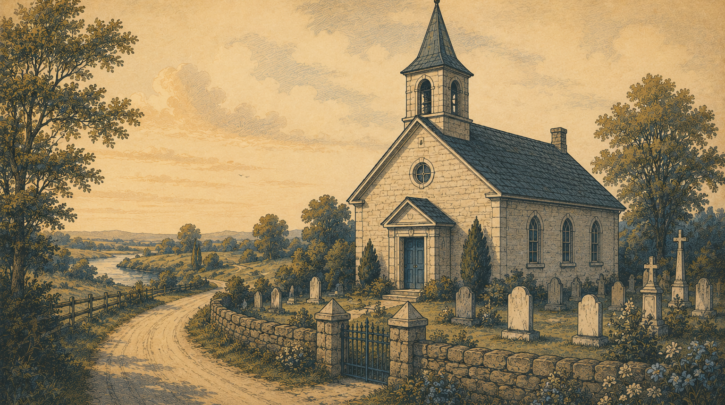
Most historic Québec parishes still have a church, though not always the original building—fires, growth and changing congregations mean many are second or third structures on the same site. Even where the building has changed, the location, the parish cemetery and the community endure. A little searching will tell you whether your ancestral church is still active, has been repurposed, or has been replaced, and what you will find when you arrive.
Parish consolidation has accelerated in recent decades as rural populations shrank, so some parishes have merged and a few churches have closed or been sold. This makes contacting the parish ahead of your visit more important than it once was—you want to know who holds the keys and the records before you travel.
Step three: make contact before you go
A little outreach transforms a parish visit. Reaching out in advance lets you arrange access, ask about the original registers, and locate the family plot in the cemetery. When you write:
- Write in French if you can, even imperfectly—it is courteous and often opens doors. A short, warm note explaining that you descend from a family of the parish goes a long way.
- Be specific about your line — name the ancestors and the years, so the parish can tell you what survives and what you might see.
- Ask about the cemetery — whether old stones survive, whether there is a plan of the plots, and whether anyone can help you find your family’s.
- Respect that parishes are working communities, often with limited staff. Patience and gratitude get you everywhere; a Sunday Mass may be the easiest time to find someone.
Step four: visit the cemetery
For many travellers the parish cemetery is more moving than the church. Here the founding names of your family—often with their dit names and spelling variants—are carved in stone, generation beside generation. Older stones may be weathered or gone, and Québec’s oldest burials predate permanent markers, but even a nineteenth-century family plot connects you physically to people you have only known on paper.
Bring your traced line, a notebook and a camera. Photograph the stones—both for your own records and to share with the cousins and fellow researchers who will treasure them. If you find the plot, take a moment. This, in the end, is what the whole journey through the registers was leading to.
Step five: see the surrounding landscape
Your ancestors did not live in the church—they lived on the land around it. Drive the parish’s rangs, the long narrow farm lots running back from the river or road in the distinctive pattern of the old seigneuries. If you know the seigneurie from the notarial records, you can often identify the very stretch your family farmed. Standing in that landscape—the river they crossed, the fields they cleared, the church spire they walked to on Sundays—is what turns a name into an ancestor.
When the parish is far from the tourist track
Many ancestral parishes lie well off the usual itinerary, in the Bas-Saint-Laurent, Charlevoix, the Beauce or the Sagueanay–Lac-Saint-Jean. Reaching them takes a car and a willingness to wander, but these visits are often the most rewarding precisely because they are personal rather than touristic. Pair the parish visit with the broader heritage trip to Québec City and the island, and you have a journey that moves from the grand story of New France down to the intimate story of your own family.
Find the parish in the records first—everything follows from that. Our records hub has the tools, and the Québec heritage trip guide shows how to weave parish visits into a full itinerary.
Reading the church itself
Once you are inside your ancestral church, it rewards a slower look. The architecture, the side altars, the statues of patron saints, the commemorative plaques—all of it is the visual world your ancestors inhabited every Sunday for generations. Older Québec churches are often richly decorated, and many hold parish histories, anniversary booklets or displays that name the founding families. Ask whether such a history exists; your surname may well be in it, and a parish centenary book can be a genealogical find in its own right.
If the original registers are still held locally rather than only in the archives, seeing the actual volume your ancestor’s baptism was written in—the very page, the priest’s own hand—is unforgettable. Many parishes have transferred their old registers to diocesan or provincial archives for preservation, so do not assume; this is exactly the kind of thing worth asking about when you make contact in advance.
Photographs and respect
Photograph generously but respectfully: the church exterior and interior, the cemetery and your family’s stones, the surrounding landscape, the village. These images become part of your family record and gifts for relatives who cannot make the journey. Remember that working churches and cemeteries are sacred spaces and active communities, not tourist attractions—visit quietly, follow any posted guidance, and if a Mass or service is underway, simply join it or wait. The welcome you receive in a small Québec parish is often warm precisely because you have come, respectfully, in search of your own.
If the parish has closed or merged
Not every story ends with an open church door, and it helps to be ready for that. Where a parish has merged with neighbours or its church has closed, the registers will almost certainly have been preserved—transferred to the diocesan archive or to the BAnQ—so the records that matter to your research are safe even when the building is not. The cemetery, too, usually remains and remains visitable, often the most enduring physical link to your family in the place. A closed church is a loss, but rarely a dead end for a heritage traveller who has come prepared.
In these cases the surrounding community can still hold your family’s memory. Local historical societies, municipal offices and long-time residents are often glad to help a returning descendant, and the landscape—the rangs, the river, the road to the old church site—remains to be walked. Heritage does not live only in a single building; it lives in the ground, the names, and the people who remember, all of which can survive a parish’s reorganisation intact.