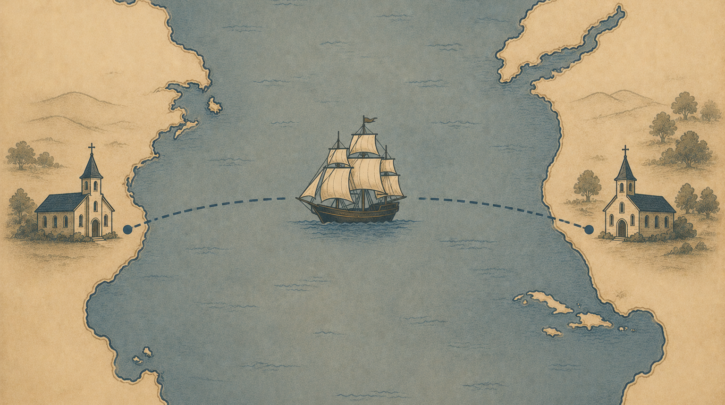

There is a moment in French-Canadian research that feels like reaching a border crossing: you have climbed your line back to the immigrant who left France, and now you want to continue on the other side of the Atlantic. Crossing that border is possible, but it is a genuine shift—different archives, a different system, and very different odds of success depending on where your ancestor came from. Here is how to make the crossing.
Step one: nail down the exact French parish
Everything depends on this. French records are organized by locality and there is no single national index, so a vague “from Normandy” is not enough—you need the specific parish. Establish it before you go looking:
- Fichier Origine — the free database that identifies many pioneers’ birth parishes; your first stop, reachable through BAnQ.
- The immigrant’s marriage contract or marriage record — which often names the home parish and diocese.
- Pioneer dictionaries — PRDH and Jétté frequently record the French origin with a source.
Confirm the parish from more than one source if you can; it is the single fact your French research will live or die by.
Not sure where to start with your French-Canadian ancestry?
Get the French-Canadian Genealogy Quick-Start Checklist — a 6-step path to your first real ancestor record, plus the surname quirk that trips up almost every beginner.
Step two: go to the French archives
France’s genealogical records are administered at the departmental level, and—this is the good news—the Archives départementales of most departments have digitized their historical registers and put them online free. The two record types you want are:
- Registres paroissiaux (parish registers) — the Catholic baptisms, marriages, and burials kept before the Revolution, the French equivalent of the Québec registers you already know.
- État civil (civil registration) — the state-run vital records that began in 1792, with the parish registers serving the earlier period.
Many departments also offer tables décennales—ten-year indexes to the civil records—that make searching far faster. Navigation is in French and varies by department, but the records themselves follow familiar formulas, and your paleography skills transfer directly.
Identifying your immigrant ancestor is a records job: work back through marriages on Généalogie Québec and PRDH-IGD until you reach the one born in France, then use the free Fichier Origine via BAnQ to pin down the French parish.
What to expect: the honest part
Set your expectations carefully, because this is where many French-Canadian trees finally stop. Several realities shape the outcome:
- Survival varies enormously. Some French parishes have registers reaching back to the 1500s; others lost theirs to war, fire, revolution, or neglect. Your success depends heavily on which parish you trace to.
- Pre-1600 records are scarce. Parish registration spread through the 1500s, so even where records survive, the trail often thins out around 1600.
- The colonial record may be your best evidence of origin. Sometimes the Québec marriage that names the French parish is more legible and accessible than anything surviving in France itself.
None of this should discourage you—many lines do continue in France for several generations—but it explains why the true brick wall in French-Canadian genealogy is usually on the French side, not the Canadian one.
Does reaching France help with citizenship?
Genealogically, crossing into France is the goal; legally, it rarely changes your status. Descending from a seventeenth-century French emigrant does not, in almost all cases, qualify you for French citizenship—the lineage is far too distant for nationality by descent. If citizenship is your aim, the relevant question is Canadian citizenship through a more recent Canadian-born ancestor, which is an entirely separate analysis.
Recommended reading (available on Amazon):
- French-Canadian Sources: A Guide for Genealogists
- A Genealogist’s Handbook for French-Canadian Research
Frequently asked questions
Are French records online and free?
Largely, yes. Most French Archives départementales have digitized their parish and civil registers and offer them free online, though each department’s site works a little differently and is in French.
Why did my line stop at the immigrant?
Usually because the French parish’s records didn’t survive, or the immigrant’s exact origin was never recorded. Re-check the marriage contract and Fichier Origine before concluding the trail is truly cold.
Using the Archives départementales
Once you have the exact parish, identify which French department it falls in today, then go to that department’s Archives départementales website. Nearly all of them host their digitized parish and civil registers free of charge. The typical path is to select the commune (town), then the register type and date range, then browse the scanned pages—much like browsing the Drouin images, only on a French archive’s viewer. Each department’s interface differs and is in French, so allow a little time to learn the navigation for your specific department.
Tables décennales: your shortcut
For the post-1792 civil records, look for the tables décennales—decennial indexes that list births, marriages, and deaths in ten-year blocks. They let you find the right year quickly instead of paging through a decade of registers. For the pre-Revolution parish registers there is usually no such index, so you read chronologically, which is why pinning down a tight date range from the Canadian records first pays off.
When the records simply don’t survive
Sometimes you reach the right parish and the registers for the era you need are gone. Before giving up, try: neighboring parishes (your ancestor may have been baptized one parish over); other record types such as notarial or seigneurial records held by the department; and published local genealogies, since French local historians have reconstructed many parishes. But accept that for some lines, the colonial Québec record naming the French parish will be the last solid evidence you get—and that is still a remarkable distance to have traveled.
Free gateways beyond the departmental archives
The Archives départementales are your primary destination, but they are not the only free route into French records. FamilySearch, the free genealogy service, has digitized and indexed large quantities of French parish and civil records and is worth searching in parallel—sometimes it surfaces a record, or an index to one, faster than the departmental viewer. Local and regional genealogical societies in France have also transcribed many parishes. Cross-checking these against the original registers on the departmental site is the same triangulation habit that serves you so well on the Canadian side.
Keeping both halves of the tree aligned
As your research straddles the Atlantic, keep your sourcing rigorous so the two halves connect cleanly. Record, for the immigrant, exactly which Canadian document named the French parish and which French record confirmed the family there—because the join between your Canadian and French research is the most important link in the whole tree, and the one most prone to a hopeful but unproven leap. Done carefully, crossing into France extends a well-documented line; done carelessly, it grafts a stranger’s family onto yours.