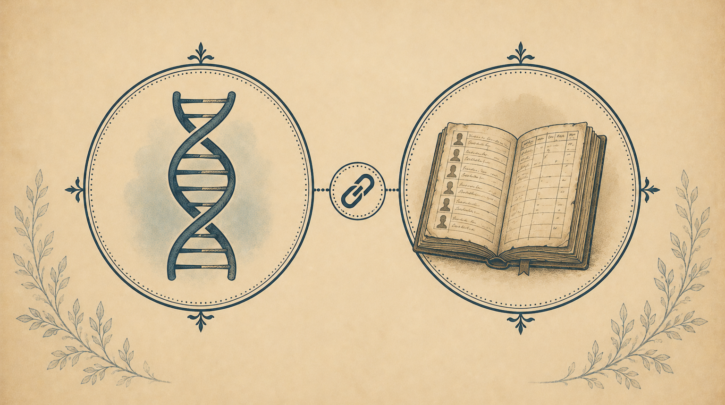

A DNA match is a clue, not a conclusion. The work that turns it into genuine genealogy—and that protects you from the false connections endogamy manufactures—is anchoring every match in the documents. For French-Canadians this is not only possible but unusually easy, because Québec’s records are among the most complete on earth. This is the method for moving from “we share DNA” to “here is exactly how, proven in the registers.”
Why records, not centimorgans, settle it
In an outbred population you might reasonably infer a relationship from shared DNA alone. In an endogamous one you cannot: the shared-cM total is inflated and reflects many ancestral paths at once, so the number tells you that you are related, not how. The only thing that establishes the specific relationship is a documented descent on both sides to a common ancestor. Fortunately, for Québec families that documentation almost always exists—in the parish registers and the PRDH index.
Not sure where to start with your French-Canadian ancestry?
Get the French-Canadian Genealogy Quick-Start Checklist — a 6-step path to your first real ancestor record, plus the surname quirk that trips up almost every beginner.
The workflow, step by step
- Form a hypothesis. From shared surnames, shared matches, or a ThruLines/Theory suggestion, identify a candidate common ancestor or couple.
- Document your own descent. Build your line down from that couple to yourself, one generation at a time, with a baptism, marriage or burial record for each link. Verify each entry in PRDH and pull the image from the Drouin Collection.
- Document the match’s descent. Do the same for their line down from the same couple. Their tree, if they have one, is a starting point—but confirm it in the records rather than trusting it.
- Check for multiple connections. In an endogamous tree you may find you connect to the same match through more than one couple. Note them all; this is normal and explains the inflated cM.
- Record your evidence. For every link, note the record, date, parish and source. A tree built this way survives scrutiny—and is the only kind that counts for anything formal.
Working with the Drouin Collection
Because AncestryDNA and the digitized Drouin parish registers live on the same platform, the path from a match to its proof can be remarkably short: open the shared ancestor in your tree, follow the record hints to the baptism and marriage images, and read the entries yourself. If you are new to the handwriting and the Latin and French formulas, our guide to reading old French-Canadian records will get you reading the registers confidently. The Drouin Collection guide covers navigation and coverage.
The Drouin images and PRDH index are the engine of this whole process. See current access options—Généalogie Québec, Ancestry, and the others—on our records hub.
When DNA breaks a brick wall
Sometimes the records run out before the DNA does, and that is where a match earns its keep. If you cannot document a parent—an unrecorded birth, an illegitimacy or a gap in the registers—a cluster of matches who all descend from a particular couple can point you to the missing link. You still confirm it in the records wherever any exist, but DNA can tell you which records to go looking for. This is the legitimate, powerful use of genetic genealogy: not to replace the documents, but to aim them.
A crucial limit: DNA and citizenship
If your interest in proving a line is Canadian citizenship by descent, understand that DNA evidence carries no weight in a citizenship application. Citizenship is established through certified vital records—long-form birth, marriage and death certificates from the issuing authority—not through a match list or a shared-cM total. DNA may help you find the relationships you then need to document, but the proof IRCC accepts is the paper. This is informational only and not legal advice; for an application, verify current requirements and consider a licensed professional.
The payoff of doing it properly
A French-Canadian tree built by anchoring DNA in records is something rare: a family history that is both genetically and documentarily proven, resistant to the endogamy that fools the automated tools, and solid enough to stand behind whether your goal is simply to know your family or to make a formal claim. The discipline of confirming every match in the registers is, for Québec roots, not a burden but a privilege—the records are there, waiting, in a depth most genealogists can only envy.
Pull it all together: choose your test on the DNA hub, find and sort your cousins with our matching workflow, and ground the whole tree in the Québec records.
A note on tree-sharing and accuracy
A DNA match’s own tree is a gift and a trap. It can save you hours by pointing at the likely common ancestor—but online trees are riddled with copied errors, and in an endogamous population a single wrong link can appear to be “confirmed” by DNA when the real connection runs through an entirely different couple. Treat every borrowed tree as a hypothesis. Pull the actual baptism, marriage and burial records yourself, read them, and only then accept the link. The discipline is the difference between a tree that looks impressive online and one that is actually true.
This matters doubly for French-Canadian families because the records make verification so achievable. Where a researcher in another tradition might be forced to accept an unsourced tree for lack of alternatives, you can almost always find the original register entry. There is rarely a good excuse to leave a link undocumented when the Drouin images and the PRDH index are a few clicks away.
Keeping your evidence organised
As your verified connections accumulate, keep them in order. For each documented link, record the event, date, parish, and exactly where you found the record, so that anyone—including a future you—can retrace the proof. Genealogy software or even a simple spreadsheet works; the point is that a relationship confirmed by both DNA and a sourced record is only as good as your ability to show the record when asked. For formal purposes such as citizenship, that documented chain is the whole ballgame—and a habit of careful sourcing now saves enormous effort later.
When the records and the DNA seem to disagree
Occasionally you will document a line carefully and then find that the DNA does not cooperate—a match who should share a meaningful amount shares too little, or someone shares far more than the paper relationship predicts. In an endogamous population, the second case is usually just endogamy doing its work: extra shared DNA arriving through additional, older lines you have not yet mapped. The first case—too little shared DNA—is the one that deserves a careful look, because it can occasionally signal a misattributed parentage somewhere in the documented chain that the records, however complete, recorded in good faith but inaccurately.
When records and DNA appear to conflict, resist the urge to force them into agreement. Re-examine the documents first: confirm you have the right individuals, that you have not crossed two families sharing a name and parish, and that each link genuinely rests on a primary record rather than a borrowed tree. If the paper trail is sound and the DNA still dissents, you may have uncovered something real—an event the registers could not capture. Handle such findings with discretion and care, especially where living people are involved, and document your reasoning as thoroughly as you document your sources. These moments are rare, but they are where DNA earns its place alongside the records rather than merely confirming them.