
It is a hopeful and entirely reasonable question. If your ancestor was born in France and helped settle New France, does that give you a claim to French citizenship today? Many people with French-Canadian roots wonder, and a few websites hint that the door might be open. The honest answer, in almost every case, is no—and it is better to understand why now than to chase a path that doesn’t exist. This article explains the reality and points you toward the route that genuinely may be available. It is general information, not legal advice.
Important: This article is general information, not legal advice, and we are not lawyers. Canadian citizenship rules changed recently and remain in flux—the documentary standard was tightened during a review in June 2026—and eligibility is determined individually by Immigration, Refugees and Citizenship Canada (IRCC). Always confirm the current rules on the official canada.ca website, and consult a licensed Canadian immigration lawyer or a Regulated Canadian Immigration Consultant (RCIC) about your own situation.
Not sure where to start with your French-Canadian ancestry?
Get the French-Canadian Genealogy Quick-Start Checklist — a 6-step path to your first real ancestor record, plus the surname quirk that trips up almost every beginner.
Why New France ancestry doesn’t confer French citizenship
French nationality by descent does pass from parent to child, but it does not reach back indefinitely. The ancestors who connect French-Canadians to France—the pioneers who emigrated in the seventeenth and early eighteenth centuries—are simply too many generations removed. A line running back ten or twelve generations to a settler who left France around 1670 does not, under modern French nationality law, make a present-day descendant French. The connection is real genealogically and meaningless legally, because nationality by descent contemplates a recent, continuous transmission, not a centuries-old origin.
There is also the matter of intervening generations: French nationality can lapse across a family that has lived abroad for generations without maintaining it, and a seventeenth-century departure is the very definition of that. In short, the romance of the New France connection does not translate into a French passport.
The contrast with Canadian citizenship
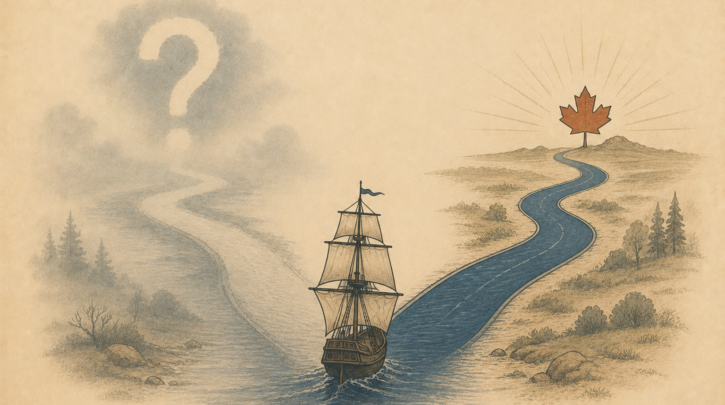
This is exactly where the Canadian path differs—and why it is worth understanding the distinction. Canadian citizenship by descent, especially after Bill C-3, can run through a recent Canadian-born ancestor: a great-grandparent born in a Québec parish before the family moved to the United States, for instance. The anchor there is a person born in Canada within the last few generations, not a settler who crossed the Atlantic three centuries ago. One path asks you to reach back a handful of generations to Canada; the other would require reaching back across the entire history of New France to France—which is why the first can work and the second cannot.
Wondering whether your family line might qualify? Start with our Am I a Canadian Citizen? overview—a plain-language walk-through of the questions that determine whether your case is worth investigating, with next steps if it is.
What about other routes to French citizenship?
To be complete: France does offer paths to citizenship, but they are the ordinary ones available to anyone—such as naturalization through extended residence in France, or marriage to a French citizen—and they have nothing to do with a New France ancestor. There is no special ancestral shortcut for descendants of French colonists in Canada. If French citizenship genuinely interests you, the realistic routes are the standard residency- and marriage-based ones, and the authoritative source is the French government, not a genealogy site. Anyone seriously pursuing it should consult French nationality authorities or a qualified French immigration lawyer.
Where to put your energy instead
If your underlying goal is a second citizenship connected to your heritage, the productive place to look is Canada, not France. The Canadian citizenship by descent path is a realistic possibility for many people of French-Canadian descent, and the research you would do to pursue it—building a documented line back through Québec records—is the same research that connects you to your French origins for their own sake. You may not become French by finding your New France ancestor, but you may well become Canadian by finding a more recent one, and you will certainly come to know your family’s story either way.
So enjoy the New France connection for what it is: one of the best-documented ancestral links in the world, a line you can often trace to a specific French village. Just don’t expect it to come with a French passport—and do look closely at whether it comes with a Canadian one.
Frequently asked questions
Can I get French citizenship because my ancestor came from France in the 1600s?
Almost certainly not. French nationality by descent does not reach back across so many generations; a seventeenth-century emigrant is far too distant. The realistic routes to French citizenship are the standard residency- and marriage-based ones.
Is Canadian citizenship by descent really more achievable?
For many people with French-Canadian roots, yes—because it can run through a recent Canadian-born ancestor rather than a centuries-old one. See our Canadian citizenship by descent guide, and confirm your situation with a professional.
Why the myth persists
If the answer is so clearly no, why does the hope keep circulating? Partly because the New France connection feels so close when you research it—tracing a line to a named French village in Normandy or Perche creates a powerful sense of belonging that the law simply does not honor. Partly because other countries do offer ancestral citizenship with longer reach, so people reasonably assume France might too. And partly because some websites blur the line to attract attention. Understanding that the emotional reality and the legal reality diverge here saves a great deal of wasted effort.
The narrow provisions people ask about
French nationality law does contain reintegration and recognition provisions for people who lost French nationality, but these contemplate a relatively recent French lineage and continuous connection—nothing that reaches back across the centuries to a colonial emigrant. There is no ancestral-citizenship program for descendants of New France settlers, and no provision that treats a seventeenth-century departure as a live claim today. If you encounter a source suggesting otherwise, treat it with skepticism and check directly with French nationality authorities.
What the connection is actually good for
A New France ancestor is not a passport, but it is something genealogically rare and valuable: a documented link from a living person to a specific French parish three or four centuries ago, traceable through some of the best records in the world. Treasure it as heritage, use it to extend your research into France for its own sake—and direct any citizenship hopes toward the Canadian path, where a recent ancestor can make a real difference.
The bottom line
Set the hope aside cleanly so you can put your energy where it pays off. Descending from a New France settler is a magnificent piece of heritage and, in most cases, legally irrelevant to French citizenship—the lineage is centuries too distant, and France offers no ancestral shortcut for it. What the connection genuinely offers is one of the world’s best-documented links to a specific place and time, and a foundation for research that may, through a more recent Canadian-born ancestor, point toward a citizenship that is within reach: the Canadian one. Enjoy the French origin as the remarkable family story it is, pursue the Canadian question seriously if your tree supports it, and rely on official sources and qualified professionals for any citizenship decision in either country.