
Acadian heritage travel is a journey through one of the most dramatic stories in North American history: the founding of Acadie, the trauma of the Grand Dérangement, and the remarkable survival and revival of a people scattered to the winds. If your roots run to Acadie—whether your family stayed in the Maritimes, returned from exile, or became Cajuns in Louisiana—these are the places where that story lives. As with any roots trip, it is richest when you have first traced your own line.
Grand-Pré: the heart of Acadian memory
No place is more central to Acadian identity than Grand-Pré, in Nova Scotia’s Annapolis Valley. It was here, in 1755, that British forces read the order of deportation to the assembled Acadian men, beginning the expulsion that tore a people from the land they had farmed for over a century. Today the Grand-Pré National Historic Site—designated a UNESCO World Heritage Site in 2012—preserves and commemorates that ground.
- The memorial church — a place of pilgrimage, with the famous statue of Évangéline, the heroine of Longfellow’s poem that fixed the Acadian tragedy in the world’s imagination.
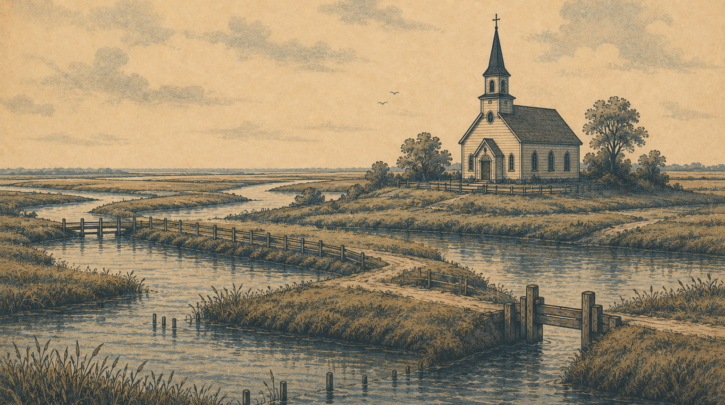
- The dyked farmland — the aboiteaux and reclaimed marshes that were the genius of Acadian agriculture, still farmed today.
- The interpretive centre — which tells the full story of settlement, deportation and return with care and depth.
Before you walk Grand-Pré, find your own family in the story. Our Acadian genealogy guide shows how to trace Acadian lines through their distinctive records, and a DNA test can connect you with Acadian cousins across the diaspora.
Not sure where to start with your French-Canadian ancestry?
Get the French-Canadian Genealogy Quick-Start Checklist — a 6-step path to your first real ancestor record, plus the surname quirk that trips up almost every beginner.
New Brunswick: living Acadie
If Nova Scotia holds the memory of the deportation, New Brunswick is where Acadie lives most vividly today, home to a large, vibrant French-speaking Acadian population. Several places belong on any heritage itinerary:
- Village Historique Acadien (near Caraquet) — a superb living-history museum recreating Acadian life from the post-deportation return through the early twentieth century, with costumed interpreters and restored buildings.
- The Acadian Peninsula — Caraquet, Shippagan and the surrounding coast, the cultural heartland of modern Acadie.
- Memramcook — often called the cradle of modern Acadie, where the people regathered after the expulsion and where the Acadian renaissance took shape.
- The Baie-des-Chaleurs — the bay straddling northern New Brunswick and the Québec Gaspésie, dotted with Acadian and mixed communities.
National Acadian Day and the Congrès Mondial Acadien
To experience Acadie at full voice, time your visit to a celebration. National Acadian Day, August 15, fills the Maritimes with the tintamarre—a joyful, deliberately noisy parade where Acadians take to the streets banging pots, blowing horns and waving the blue-white-red star-flag, a centuries-old declaration that they are still here.
Larger still is the Congrès Mondial Acadien, the World Acadian Congress, held every five years in a different Acadian region. It gathers Acadians from across Canada, the United States, Louisiana and France for weeks of family reunions, concerts and cultural events. The 2024 edition was held in the Clare and Argyle regions of southwestern Nova Scotia; the next, the eighth, will take place August 8–18, 2029 in the Baie-des-Chaleurs region spanning northern New Brunswick and the Québec Gaspésie, with the opening at Bonaventure. If you can plan a roots trip around a Congrès—and especially around the family reunion for your own surname—it is an experience without equal in the Franco world.
Following the deportation trail
For many descendants the Acadian story did not end in the Maritimes but scattered across the Atlantic world. The deportees were dispersed to the British colonies along the eastern seaboard, to England and France, and ultimately many made their way to Louisiana, where they became the Cajuns. A fuller heritage journey can follow that trail:
- Louisiana’s Acadiana — the Lafayette region, where Cajun culture, music and cuisine flourished and where the Acadian Memorial at St. Martinville honours the exiles who arrived.
- France — particularly the Belle-Île-en-Mer and Poitou regions, where some deportees were resettled, and the port of Nantes, from which many later sailed to Louisiana.
Plan around your own lines
As with a Québec heritage trip, the key to a meaningful Acadian journey is doing the genealogy first. Trace your line, identify the specific communities—Grand-Pré, Beaubassin, Port-Royal, Memramcook, or a Louisiana parish—your family belonged to, and let those places anchor your route. Acadian records have their own character and their own gaps, especially around the deportation; our Acadian genealogy guide will help you push through them. Then go and stand on the dyked marshes, hear the tintamarre, and meet the cousins who never stopped being Acadian.
Trace your Acadian line with our Acadian genealogy guide, connect with diaspora cousins through a DNA test, and understand the exile that shaped your family in the Grand Dérangement.
Understanding Acadian records before you travel
Acadian genealogy has a character all its own, and knowing it shapes a heritage trip. The early Acadian settlements kept registers like any Catholic community, but the deportation of 1755 scattered people and destroyed or dispersed records, leaving gaps that Québec families rarely face. Much of what survives was painstakingly reconstructed by later scholars, and Acadian lines often run through compiled genealogies as much as through original parish books.
This matters for the traveller because it changes what you are looking for on the ground. Where a Québec pilgrim seeks a continuous parish, an Acadian descendant is often tracing a family across rupture—from a pre-deportation community like Grand-Pré, Beaubassin or Port-Royal, through exile, to a place of return or resettlement. Our Acadian genealogy guide helps you map that journey before you make it, so the sites you visit tell your family’s specific story of loss and survival rather than a generic one.
Port-Royal and the Annapolis Valley
Beyond Grand-Pré, the Annapolis Valley holds the site of Port-Royal, one of the earliest European settlements in North America and a cradle of Acadie. The reconstructed Port-Royal Habitation evokes the first decades of Acadian life in the early 1600s, before the communities spread along the Bay of Fundy marshlands. Pairing Port-Royal with Grand-Pré gives a heritage traveller the full arc of mainland Acadie—foundation and flourishing, then expulsion—within a short and beautiful drive.
Île Sainte-Croix, Louisbourg and the wider Acadian map
Acadie was never confined to the Annapolis Valley, and a fuller heritage journey can take in its wider geography. The Fortress of Louisbourg on Cape Breton—a vast reconstruction of the great French fortified town—immerses you in the military and maritime world of eighteenth-century French North America that shaped Acadian fortunes. Prince Edward Island (Île Saint-Jean) held Acadian settlements that suffered their own deportation. And along the Bay of Fundy, the marshland sites of the early communities reward anyone tracing a pre-1755 line.
Plotting these places against your own genealogy is what turns a regional tour into a personal pilgrimage. An Acadian family history is, almost by definition, a history of movement—settlement, dispersal, return or exile—and the map of your trip should trace that movement. Whether your line ends in the Maritimes, in Louisiana, in France, or back in Québec where some refugees settled, the sites you choose tell the particular story of how your family weathered the storm that broke over all of Acadie in 1755.